Enjoy Free US Domestic Shipping on Orders Over $400+

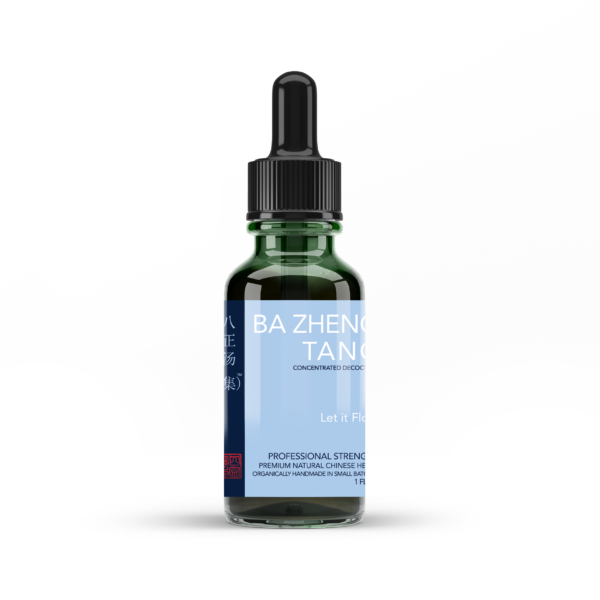
Ba Zheng Tang 八正湯
Login to view prices
- ACM/CCM/TCM Global Status: Safe & Effective
Let it Flow™ – 1oz
This is Si Jin Bao’s version of a classical formula that dates back to the 10th century. It is well known for addressing symptoms of urgent, frequent, & burning urination, heavy feeling in the lower abdomen, and very little urine that is dark yellow. It is commonly used for Urinary Tract Infections.
Classical Formula · Song Dynasty · c. 1107
八正湯
Eight-Herb Decoction for Rectification
Let it Flow™
Over Nine Centuries in Continuous Clinical Use
The Formula
Clear the Heat, Open the Flow
Bā Zhèng Tāng — the Eight-Herb Decoction for Rectification, known as Let it Flow — is Si Jin Bao’s concentrated decoction of the classical Song-dynasty formula for Damp-Heat lodged in the bladder: the urgent, frequent, burning, scanty urination of Damp-Heat painful urinary dysfunction.
Recorded in the Song imperial formulary nine centuries ago, Ba Zheng San — the “Eight Corrections Powder” — assembles herbs that drain Heat and Damp downward and out through the urine, opening a urinary tract that Heat has inflamed and obstructed. Si Jin Bao renders the classical powder as a concentrated, alcohol-free decoction.
Classical Foundation
From the Song Imperial Formulary
Ba Zheng San first appears in the Tài Píng Huì Mín Hé Jì Jú Fāng — the Formulary of the Pharmacy Service for Benefiting the People in the Taiping Era — the Song dynasty’s official pharmacopeia, compiled around 1107. It was created for lin syndrome, painful urinary dysfunction, of the Damp-Heat type: Heat and Damp pouring downward into the bladder, scorching the fluids and obstructing the flow of urine.
The logic has held for nine centuries. When Heat and Damp block the lower burner, the answer is neither to force the flow nor to tonify, but to clear the Heat, drain the Damp, and open the waterways — so that what is hot and stagnant leaves the body through the urine.
A Note on the Name
Bā Zhèng — “Eight [herbs that] Rectify” — names both the count of the formula’s herbs and its aim: to correct a disordered, obstructed flow of urine. The eight rectify; in decoction the formula adds Dēng Xīn Cǎo to guide the Heat out through the water.
The Pattern
Damp-Heat in the Bladder · 膀胱濕熱
The pattern is Damp-Heat pouring into the bladder and lower burner — Heat that burns and Damp that obstructs — frequently with Heat in the Heart channel transferring to the Small Intestine. Urine turns scanty, dark, and turbid; urination becomes urgent, frequent, and burning; the lower abdomen feels full and heavy.
Clinical Indications
- Discomfort and bloating in the lower abdomen
- Dark, turbid urination
- Scanty, difficult, painful urination
- Burning, frequent urination
- Lower back pain
- Chills and fever; bitter taste in the mouth; thirst
Classical tongue & pulse: a red tongue with a greasy yellow coating; a slippery, rapid pulse.
How It Works
Nine Herbs: Clear, Drain, Unblock
Mù Tōng and Huá Shí lead — Mù Tōng drains Heat from the Heart and conducts it down to the Small Intestine while freeing the flow of urine, and Huá Shí clears Heat and drains Damp through the urine. Qú Mài, Biǎn Xù, and Chē Qián Zǐ promote urination and unblock the painful, obstructed flow.
Zhī Zǐ clears Heat from all three burners and directs it downward and out through the urine; Dà Huáng drains Heat through the stool, giving the Damp-Heat a second route out of the body. Dēng Xīn Cǎo guides Heart Heat out through the urine, and Gān Cǎo harmonizes the formula, eases the urinary pain, and tempers the cold, draining herbs so the whole works as one. Clear, drain, unblock.
Clinical Recognition
When to Reach for It
Reach for Bā Zhèng Tāng for the acute, hot, obstructed urinary presentation — urgent, frequent, burning urination with scanty, dark urine and a heavy, full lower abdomen — where Damp-Heat in the bladder dominates. It is the classical answer to Damp-Heat lin syndrome.
Western conditions and terminology that are commonly associated with these TCM patterns:
- Cystitis, urethritis, and pyelonephritis
- Prostatitis; urinary tract calculi
- Glomerulonephritis; edema
- Vaginitis; urinary incontinence; polyuria
通淋
The Si Jin Bao Preparation
Si Jin Bao’s Bā Zhèng Tāng is a concentrated decoction of the classical eight-herb powder, prepared in small batches using traditional methods — alcohol-free, no fillers. A formula meant to open and clear the body’s waterways is itself made clean, with nothing added that the body must work to clear.
Materia Medica · 本草
八正湯
Bā Zhèng Tāng
Eight-Herb Decoction for Rectification
Let it Flow™
The eight classical herbs of Ba Zheng San — with Dēng Xīn Cǎo to guide them — assembled to clear Heat, drain Damp, and open the urinary flow obstructed by Damp-Heat in the bladder. Below, each herb in its own right: nature, channels, classical actions, and its role in this formula.
01
Herb 01
木通
Caulis Akebiae
Akebia Stem
CategoryDrain Dampness · Unblock Painful Urination
Nature & FlavorBitter; Cold
ChannelsHeart · Small Intestine · Bladder
Actions
Promotes urination and drains Damp-Heat; clears Heat from the Heart and conducts it downward to the Small Intestine; unblocks painful urinary dysfunction.
Indications
Damp-Heat painful urination; Heart Fire transferring to the Small Intestine, with mouth and tongue sores and dark, scanty urine.
Classical Reference
Documented in the classical materia medica among the herbs that free the flow of urine and drain Heat downward. Si Jin Bao uses the Akebia source (Caulis Akebiae).
Role in this Formula
Drains Heat from the Heart and Small Intestine and frees the flow of urine — a leading herb of the formula, paired with Huá Shí.
02
Herb 02
瞿麥
Herba Dianthi
Fringed Pink / Dianthus
CategoryDrain Dampness · Clear Damp-Heat
Nature & FlavorBitter; Cold
ChannelsHeart · Small Intestine · Bladder
Actions
Promotes urination and unblocks painful urinary dysfunction; clears Damp-Heat; invigorates the Blood.
Indications
Damp-Heat painful urination, including with blood or stones; hot, painful, scanty urination.
Classical Reference
Recorded in the Shén Nóng Běn Cǎo Jīng (神農本草經), among the herbs for hot, obstructed urination.
Role in this Formula
Promotes urination and unblocks the painful, obstructed flow — one of three herbs opening the waterways.
03
Herb 03
萹蓄
Herba Polygoni Avicularis
Knotgrass
CategoryDrain Dampness · Clear Damp-Heat
Nature & FlavorBitter; Slightly Cold
ChannelsBladder
Actions
Promotes urination and drains Damp-Heat; unblocks painful urinary dysfunction; kills parasites and relieves itching (chiefly external).
Indications
Damp-Heat painful urination; hot, burning, difficult urination.
Classical Reference
Recorded in the Shén Nóng Běn Cǎo Jīng (神農本草經), among the Damp-Heat-draining herbs for the bladder.
Role in this Formula
Drains Damp-Heat through the urine, easing the burning dribble — working alongside Qú Mài and Chē Qián Zǐ.
04
Herb 04
車前子
Semen Plantaginis
Plantain Seed
CategoryDrain Dampness · Clear Damp-Heat
Nature & FlavorSweet; Cold
ChannelsKidney · Liver · Lung · Bladder
Actions
Promotes urination and clears Damp-Heat; separates the clear from the turbid; clears Liver Heat and brightens the eyes; clears Lung Heat.
Indications
Damp-Heat painful urination; scanty, difficult, turbid urination.
Classical Reference
Recorded in the Shén Nóng Běn Cǎo Jīng (神農本草經), a principal seed for draining Damp through the urine.
Role in this Formula
Promotes urination and clears Damp-Heat, separating the turbid from the clear so the urine runs clean again.
05
Herb 05
滑石
Talcum
Talcum
CategoryDrain Dampness · Clear Damp-Heat & Summer-Heat
Nature & FlavorSweet, Bland; Cold
ChannelsBladder · Stomach
Actions
Promotes urination and drains Damp-Heat; clears Summer-Heat; (applied externally) absorbs Dampness and dries weeping lesions.
Indications
Damp-Heat painful urination with hot, scanty, difficult urine; Summer-Heat with thirst and scanty urination.
Classical Reference
Recorded in the Shén Nóng Běn Cǎo Jīng (神農本草經), a cooling mineral for the hot, obstructed bladder.
Role in this Formula
Clears Heat and drains Damp through the urine — a cooling, unblocking mineral that leads the formula alongside Mù Tōng.
06
Herb 06
梔子
Fructus Gardeniae
Gardenia Fruit
CategoryClear Heat · Drain Fire
Nature & FlavorBitter; Cold
ChannelsHeart · Lung · Stomach · Triple Burner
Actions
Drains Heat and relieves irritability; clears Heat from the three burners and directs Damp-Heat downward and out through the urine; cools the Blood and resolves toxicity.
Indications
Heat in the three burners; Damp-Heat with dark urine; irritability and restlessness from Heat.
Classical Reference
Recorded in the Shén Nóng Běn Cǎo Jīng (神農本草經), a principal herb for draining Fire from the three burners.
Role in this Formula
Clears Heat from all three burners and channels it downward and out through the urine, joining the formula’s draining to its cooling.
07
Herb 07
大黄
Radix et Rhizoma Rhei
Rhubarb Root & Rhizome
CategoryDrain Downward · Purge Accumulation
Nature & FlavorBitter; Cold
ChannelsSpleen · Stomach · Large Intestine · Liver · Pericardium
Actions
Drains Heat and purges accumulation downward; clears Heat and resolves toxicity; cools the Blood and dispels stasis.
Indications
Interior Heat excess; Heat with constipation; Heat in the Blood; Damp-Heat patterns needing a downward route.
Classical Reference
Recorded in the Shén Nóng Běn Cǎo Jīng (神農本草經), the principal purgative of the materia medica.
Role in this Formula
Drains Heat through the stool, giving the Damp-Heat a second route out of the body — downward, alongside the urinary route.
08
Herb 08
燈芯草
Medulla Junci
Rush Pith (Juncus)
CategoryDrain Dampness · Clear Heart Heat
Nature & FlavorSweet, Bland; Slightly Cold
ChannelsHeart · Lung · Small Intestine
Actions
Promotes urination and drains Damp-Heat; clears Heart Heat and relieves restlessness, quieting the spirit.
Indications
Damp-Heat painful urination; Heart Heat with irritability and restlessness.
Classical Reference
Documented in the classical materia medica as a light herb that clears Heart Heat through the urine.
Role in this Formula
Guides Heart Heat out through the urine — the light envoy that points the formula at the water pathways.
09
Herb 09
甘草
Radix Glycyrrhizae
Licorice Root
CategoryTonify Qi · Harmonize
Nature & FlavorSweet; Neutral
ChannelsHeart · Lung · Spleen · Stomach
Actions
Clears Heat and resolves toxicity; moderates and harmonizes the other herbs; the tips (Gān Cǎo Shāo) are traditionally used to clear Heat from the urinary tract and ease painful urination.
Indications
Heat-toxicity; painful urination (the tips); the need to temper strong, cold, draining herbs.
Classical Reference
Recorded in the Shén Nóng Běn Cǎo Jīng (神農本草經), traditionally called the great harmonizer of the materia medica.
Role in this Formula
Harmonizes the formula, eases urinary pain, and tempers the cold, draining herbs so the whole works together as one.
10
Herb 10
蔬菜甘油
Glycerinum Vegetabile
Vegetable Glycerin
Nature (性)
Neutral · 平 Píng
Taste (味)
Sweet · 甘 Gān
Category
Excipient · Carrier
Traditional Actions (功效)
Harmonizes and guides the other medicinals to their target tissues. Analogous to synovial fluid — providing a medium for smooth movement and deep delivery throughout the decoction.
Role in this Formula
Excipient function: Dissolves and stabilizes the botanical constituents of the formula, ensuring consistent delivery in decoction form. Mucosal hydration: By attracting and retaining water, glycerin keeps the oral and digestive mucosa moist. Patient tolerance: Its naturally sweet, neutral profile makes the formula palatable for children and adults alike.
Modern Research
International Journal of Pharmaceutics · 2023
Glycerin serves as a co-solvent and humectant in oral liquid formulations, enhancing solubility of poorly water-soluble compounds, stabilizing active ingredients, and improving mucosal hydration.
Journal of Clinical Pharmacology · 2018
Oral glycerol has been widely used as an osmotic agent. Doses of 1–1.5 g/kg are safe and well-tolerated; its mechanism involves osmotic fluid redistribution between compartments.
Clinical Oral Investigations · 2022
Glycerin-containing oral moisturizers significantly improved xerostomia symptoms compared with water-based controls, enhancing mucosal hydration and prolonging moisture retention in the oral cavity.
Clinical Translation
Gān Yóu guides the physical delivery of the formula — ensuring the preparation reaches its target tissues and is tolerated long enough to do its work. A naturally sweet, neutral carrier that makes the decoction palatable for adults and children alike.
11
Herb 11
蒸餾水
Aqua Destillata
Distilled Water
Nature (性)
Neutral · 平 Píng
Taste (味)
Tasteless
Category
Vehicle · Neutral Carrier
Traditional Actions (功效)
Not a classical herb in its own right. Functions as a neutral carrier — a pharmaceutically pure vehicle that allows the active constituents of the classical herbs in the formula to extract, stabilize, and deliver without interference.
Role in this Formula
Biomedical role: A pharmaceutically pure solvent, ensuring consistent extraction and delivery of active compounds without introducing mineral ions, microbial contaminants, or chemical interference. Clinical relevance: Acts as a safe vehicle — analogous to saline in biomedicine — so that every dose of the formula performs identically, from the first bottle to the last.
Modern Research
Pharmacopeial Standard · Herbal Decoction Stability
Distilled water ensures stability, reproducibility, and safety in herbal decoction preparations by eliminating mineral ions and microbial contaminants that would otherwise compromise extraction consistency and shelf life.
Clinical Pharmacology · Oral Solution Vehicles
Distilled water is recognized in clinical pharmacology as the neutral carrier of choice for both intravenous and oral solutions, chosen specifically for its non-reactive profile with active ingredients.
Clinical Translation
Li Shi-zhen devoted an entire section of the Ben Cao Gang Mu (本草綱目) to the classification of waters — recognizing that the water in which a formula is prepared shapes the clinical outcome. SJB honors this principle by using pharmaceutically distilled water as the neutral vehicle for every decoction.
通淋
Clear, Drain, Unblock
Two herbs lead by clearing Heat and draining Damp through the urine; three open the obstructed flow; one drains Fire from the three burners and one drains Heat through the stool; one light envoy guides the Heart’s Heat to the water, and one harmonizes the whole. Assembled nine centuries ago for the hot, blocked bladder, the herbs work as a single instruction — clear the Heat, drain the Damp, and open the waterways so what is hot and stagnant leaves through the urine.
Dosage & Preparation · 用法用量
How to Prepare & Dose
Si Jin Bao Concentrated Decoctions™ are activated in hot water, steeped briefly, and taken warm. Follow the four steps below, then refer to the age-appropriate dosing grid.
Preparation
The Four Steps
-
Step 01ShakeShake the bottle well before each use.
-
Step 02Add Hot WaterAdd the age-appropriate dosage into 1 oz of hot water, as you would for tea.
-
Step 03SteepCover and steep for 5 minutes, then allow to cool to a warm, drinkable temperature.
-
Step 04DrinkDrink warm, twice daily or as directed by your practitioner.
For best results: take on an empty stomach — approximately 30 minutes before or after food or drink.
Dosage
By Age Group
Newborn
3drops
Twice daily
1 Year
7drops
Twice daily
2–6 Years
10drops
Twice daily
7 Years to Adult
20drops
Twice daily
Treatment Protocols
Suggested Clinical Course
Acute
10 Days
Then Reevaluate
Subacute
30 Days
Then Reevaluate
Chronic
90 Days
Then Reevaluate
Bottle Longevity
11½ days
at standard adult dosage
Research · 研究
八正湯
Bā Zhèng Tāng
Peer-Reviewed Evidence
Ten Studies on Ba Zheng Tang and Its Herbs
What follows is the peer-reviewed evidence behind Bā Zhèng Tāng — beginning with two clinical studies on the formula in urinary tract infection, then turning to the herbs, each selected for a documented role in clearing Heat, draining Damp, and opening the urinary flow.
01
Study 01
八正散
Randomized Controlled Trial
Chin. J. Integr. Med. · 2019
Design
Randomized, double-blind trial (n = 122 women)
Intervention
Whole formula vs antibiotics, 4 weeks
Relevance
Direct — the formula itself, in UTI
Background
Recurrent urinary tract infection in women is the exact Damp-Heat painful-urination presentation Ba Zheng San was created for. This randomized, double-blind trial compared the Chinese-medicine formula against standard antibiotics.
Findings
Among 122 women, the Bazheng Powder formula (four weeks) achieved a clinical cure rate of 90.2% versus 82.0% for antibiotics, with bacterial clearance of 88.5% versus 82.0% — supporting the formula as a viable alternative for recurrent UTI. (Registration NCT01745328.)
Relevance to Ba Zheng Tang
This is the formula itself, tested in the very condition it addresses — Damp-Heat painful urination presenting as recurrent UTI — performing comparably to antibiotics.
Citation
Treatment of Uncomplicated Recurrent Urinary Tract Infection with Chinese Medicine Formula Bazheng Powder: A Randomized Controlled Trial. Chin. J. Integr. Med. 2019;25(1):16–22. PMID: 28741061.
02
Study 02
八正散
Controlled Clinical Study
Evid. Based Complement. Alternat. Med. · 2021
Design
Controlled clinical study (n = 120 children)
Intervention
Formula as adjunct to antibiotic
Relevance
Supporting — formula as adjunct in UTI
Background
This study examined Bazhengsan as an adjunct to amoxicillin-clavulanate in children with urinary tract infection.
Findings
The combined-therapy group showed better immune-function indices and lower inflammatory-factor levels than antibiotic alone, with a higher overall effective rate (96.7%) — suggesting the formula complements conventional antibiotics.
Relevance to Ba Zheng Tang
Demonstrates the formula’s value alongside antibiotics in UTI, reducing inflammation — consistent with its Heat-clearing, Damp-draining action.
Citation
Effect of Amoxicillin and Clavulanate Potassium Combined with Bazhengsan on Pediatric Urinary Tract Infection. Evid. Based Complement. Alternat. Med. 2021;2021:4575503. PMID: 34721633.
03
Study 03
木通
Comprehensive Review
J. Ethnopharmacol. · 2021
Design
Comprehensive review (uses, chemistry, pharmacology, toxicology)
Active Compounds
Triterpenoid saponins (akebia saponins)
Relevance
Direct — diuretic, anti-inflammatory
Background
Mu Tong has been used to free urination and drain Heat. This review summarized the botany, chemistry, pharmacology, and toxicology of authentic Akebiae Caulis (A. quinata) and clarified its distinction from the nephrotoxic Aristolochia-derived “mu tong.”
Findings
Akebiae Caulis is documented for diuretic, anti-inflammatory, analgesic, and antibacterial activity, with triterpenoid saponins as principal constituents; the review affirms A. quinata as the authentic, appropriate source.
Relevance to Ba Zheng Tang
Si Jin Bao uses the Akebia source. The review documents its diuretic and anti-inflammatory pharmacology — the basis for its leading role in freeing urination and draining Heat from the Heart and Small Intestine.
Citation
Traditional uses, phytochemistry, pharmacology, and toxicology of Akebiae Caulis and its synonyms: A review. J. Ethnopharmacol. 2021. PMID: 34052351.
04
Study 04
瞿麥
Comprehensive Review
Chin. Med. · 2022
Design
Comprehensive review
Active Compounds
Triterpenoid saponins, flavonoids
Relevance
Direct — diuretic, anti-inflammatory
Background
Qu Mai (Dianthi Herba) is a classical herb for hot, painful urination. This review compiled its botany, traditional use, phytochemistry, and pharmacology.
Findings
Dianthi Herba is documented as a diuretic and anti-inflammatory agent for urinary disorders, with triterpenoid saponins and flavonoids among its active constituents.
Relevance to Ba Zheng Tang
Qú Mài promotes urination and unblocks the obstructed flow; the review documents the diuretic, anti-inflammatory pharmacology behind that role.
Citation
Dianthi herba: a comprehensive review of its botany, traditional use, phytochemistry, and pharmacology. Chin. Med. 2022;17(1):15. PMID: 35062995.
05
Study 05
萹蓄
In Vitro Mechanistic Study
Plants · 2024
Design
In vitro mechanistic study (RAW 264.7 macrophages)
Active Compounds
Flavonoids (quercetin, kaempferol)
Relevance
Direct — anti-inflammatory
Background
Bian Xu (Polygonum aviculare) has long treated inflammatory and urinary conditions. This study examined the anti-inflammatory and antioxidative mechanism of its extract in macrophages.
Findings
The extract inhibited NF-κB activity and inducible nitric oxide synthase while inducing the antioxidant enzyme heme oxygenase-1, reducing pro-inflammatory mediators.
Relevance to Ba Zheng Tang
Biǎn Xù drains Damp-Heat through the urine; this study documents the anti-inflammatory mechanism (HO-1 induction, NF-κB / iNOS inhibition) supporting that role.
Citation
Hydroethanolic Extract of Polygonum aviculare L. Mediates the Anti-Inflammatory Activity in RAW 264.7 Murine Macrophages Through Induction of Heme Oxygenase-1 and Inhibition of Inducible Nitric Oxide Synthase. Plants. 2024;13(23):3314. PMCID: PMC11644326.
06
Study 06
車前子
Experimental Pharmacology Study
Front. Pharmacol. · 2020
Design
Experimental diuretic study + metabolomics (rats)
Active Compounds
Iridoids, phenylethanoid glycosides, flavonoids
Relevance
Direct — diuretic, clears Damp-Heat
Background
Che Qian Zi (Plantaginis Semen) is described in the pharmacopeia as clearing Heat, promoting diuresis, and draining Dampness. This study assessed its diuretic effect and the metabolic changes behind it.
Findings
Plantaginis Semen produced a measurable diuretic effect, increasing urine output and altering urinary electrolyte handling, consistent with its documented anti-inflammatory and antioxidative actions.
Relevance to Ba Zheng Tang
Chē Qián Zǐ promotes urination and clears Damp-Heat, separating the turbid from the clear; this study documents the diuretic action central to its role.
Citation
Diuretic Effect and Metabolomics Analysis of Crude and Salt-Processed Plantaginis Semen. Front. Pharmacol. 2020;11:563157. PMCID: PMC7774519.
07
Study 07
梔子
In Vivo Mechanistic Study
Front. Pharmacol. · 2019
Design
In vivo mechanistic study (LPS-induced mice)
Active Compounds
Iridoid glycosides (geniposide)
Relevance
Direct — clears Heat, resolves toxicity
Background
Zhi Zi (Gardenia jasminoides) is a classical heat-clearing, detoxifying herb. This study examined the anti-inflammatory effect of Gardenia decoction in LPS-challenged mice.
Findings
Gardenia decoction markedly reduced pro-inflammatory cytokines (TNF-α, IL-6, IL-8, IL-1) and inhibited NF-κB signaling, while raising antioxidant capacity (T-AOC, SOD, GSH-Px).
Relevance to Ba Zheng Tang
Zhī Zǐ clears Heat from the three burners and channels it out through the urine; this study documents the anti-inflammatory, NF-κB-inhibiting pharmacology behind that Heat-clearing role.
Citation
Gardenia Decoction Prevent Intestinal Mucosal Injury by Inhibiting Pro-inflammatory Cytokines and NF-κB Signaling. Front. Pharmacol. 2019;10:180. PMCID: PMC6447716.
08
Study 08
大黄
Pharmacological Properties Review
Chinese Medicine · 2021
Design
Comprehensive pharmacology review
Active Compounds
Anthraquinones (emodin, rhein, chrysophanol)
Relevance
Direct — drains Heat downward
Background
Rhubarb (Da Huang) has been used for centuries to purge accumulation and clear Heat; emodin is one of its major anthraquinones. This review updated emodin’s pharmacological properties and mechanisms.
Findings
Emodin is documented for anti-inflammatory, immunomodulatory, antibacterial, and antiviral activities; rhubarb’s anthraquinone glycosides are its purgative, Heat-clearing principle.
Relevance to Ba Zheng Tang
Dà Huáng drains Heat through the stool, giving the Damp-Heat a second route out of the body — downward, alongside the urinary route.
Citation
Advances in the study of emodin: an update on pharmacological properties and mechanistic basis. Chinese Medicine. 2021. PMCID: PMC8504117.
09
Study 09
燈芯草
In Vitro Study
BioMed Res. Int. · 2022
Design
In vitro study (oral keratinocytes)
Active Compounds
Phenanthrenes (effusol, dehydroeffusol)
Relevance
Supporting — anti-inflammatory
Background
Deng Xin Cao (Juncus effusus) has been used as a diuretic, antipyretic, and to quiet the spirit. This study examined the anti-inflammatory and protective effects of its water extract.
Findings
The water extract significantly reduced LPS-induced pro-inflammatory chemokines (IL-8, CCL20) and protected epithelial cells from chemical injury.
Relevance to Ba Zheng Tang
Dēng Xīn Cǎo guides Heart Heat out through the urine; this study documents the anti-inflammatory activity supporting its light, clearing role.
Citation
Anti-Inflammatory and Protective Effects of Juncus effusus L. Water Extract on Oral Keratinocytes. BioMed Res. Int. 2022;2022:9770899. PMCID: PMC8752227.
10
Study 10
甘草
Phytochemical / Pharmacological Review
Phytother. Res. · 2018
Design
Phytochemical / pharmacological review
Active Compounds
Triterpenes (glycyrrhizin, glycyrrhetinic acid)
Relevance
Supporting — clears Heat-toxin, harmonizes
Background
Licorice (Gan Cao) is the classical harmonizer and a Heat-toxin-clearing herb. This review summarized its chemistry and pharmacology.
Findings
Glycyrrhizin and glycyrrhetinic acid are documented for anti-inflammatory and antiallergic activity, with broad use across formulas to moderate and harmonize.
Relevance to Ba Zheng Tang
Gān Cǎo harmonizes the formula and eases urinary pain — especially as the tips, Gān Cǎo Shāo; the review documents the anti-inflammatory pharmacology behind that role.
Citation
Liquorice (Glycyrrhiza glabra): A phytochemical and pharmacological review. Phytother. Res. 2018. PMCID: PMC7167772.
Mechanism Notes
How the formula’s herbs work at a biochemical level.
Mù Tōng
Triterpenoid saponins (akebia saponins) documented for diuretic and anti-inflammatory activity, with A. quinata affirmed as the authentic, non-Aristolochia source (PMID 34052351, 2021).
Qú Mài
Triterpenoid saponins and flavonoids documented for diuretic and anti-inflammatory activity in urinary disorders (PMID 35062995, 2022).
Biǎn Xù
Flavonoids (quercetin, kaempferol) documented to induce heme oxygenase-1 and inhibit NF-κB and iNOS, reducing inflammation (PMC11644326, 2024).
Chē Qián Zǐ
Iridoids and phenylethanoid glycosides documented for a measurable diuretic effect with altered urinary electrolyte handling (PMC7774519, 2020).
Zhī Zǐ
Geniposide documented to reduce pro-inflammatory cytokines (TNF-α, IL-6) and inhibit NF-κB signaling (PMC6447716, 2019).
Dà Huáng
Anthraquinones (emodin, rhein) documented for anti-inflammatory and antibacterial activity, with anthraquinone glycosides underlying the purgative action (PMC8504117, 2021).
Dēng Xīn Cǎo
Phenanthrenes (effusol, dehydroeffusol) documented to reduce pro-inflammatory chemokines (IL-8, CCL20) (PMC8752227, 2022).
Gān Cǎo
Glycyrrhizin and glycyrrhetinic acid documented for anti-inflammatory and antiallergic activity, harmonizing the formula (PMC7167772, 2018).
Western Terminology
Western conditions and terminology commonly associated with these TCM patterns:
Cystitis · Urethritis · Pyelonephritis · Prostatitis · Urinary Tract Calculi · Glomerulonephritis · Kidney Failure · Edema · Vaginitis · Urinary Incontinence · Polyuria · Intermenstrual Bleeding · Stomatitis · Hernia
通淋
Open the Waterways
Ba Zheng San is among the few classical formulas tested as a whole in modern trials — and in recurrent urinary tract infection, the very Damp-Heat presentation it was built for, it held its own against antibiotics. Beneath the formula, each herb has been examined on its own terms, and the findings converge on a single instruction: a hot, blocked bladder, cleared by draining the Heat and the Damp and opening the flow of urine. Nine centuries on, the mechanisms now have names — diuretic and anti-inflammatory, NF-κB-inhibiting and antioxidant — for what the formula has always done.
Related products
-

Bao Ji Tang 保济湯
Login to view prices -
Chuan Xiong Cha Tiao Tang 川芎茶調湯
Login to view prices -
Dao Chi San Tang 導赤散湯
Login to view prices -
A.I.R. 停止咳嗽免疫支持湯(集)
Minimum Order Quantity: 5 Login to view prices

Reviews
There are no reviews yet.