Enjoy Free US Domestic Shipping on Orders Over $400+

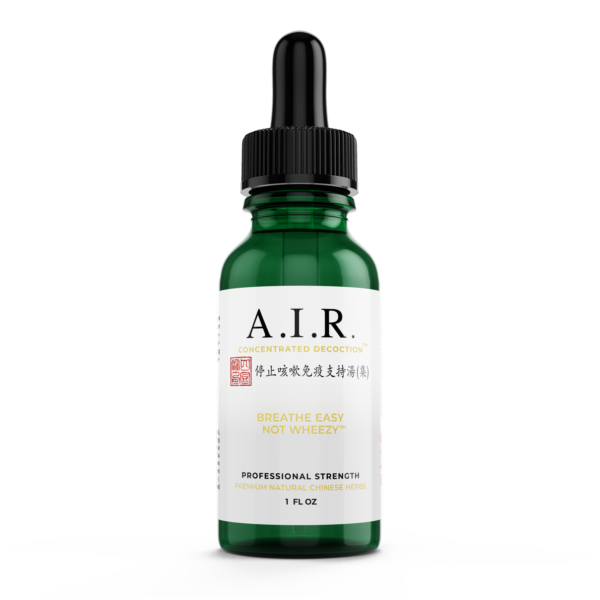
A.I.R. 停止咳嗽免疫支持湯(集)
Login to view prices
- ACM/CCM/TCM Global Status: Safe & Effective
Breathe Easy not Wheezy – 1oz
Stop Cough Immune Support Decoction
- Description
- Ingredients & Materia Medica
- Dosage Protocol
- Dosage Instructions
- Product Guide
- Research
- Reviews (0)
Concentrated Decoction · 停止咳嗽免疫支持湯
停止咳嗽免疫支持湯
A.I.R.™ Allergy Immune Respiratory™
Breathe Easy, Not Wheezy
27 Years in Service · 750,000+ Doses Delivered
Origin
Born from a Pediatrician’s Request
A.I.R.™ was designed at the request of a Holistic Pediatrician who needed something her young patients would actually take. The brief was specific: a formula that could stop coughs and clear infections in children — and that tasted good enough that parents wouldn’t have to fight to get it down. The result, refined over twenty-seven years of clinical use, is one of Si Jin Bao’s flagship formulas and one of the brand’s longest-running clinical successes.
The formula was built around a classical Chinese architecture for respiratory work: opening the nose, resolving and transforming phlegm, allowing the lungs to grasp the Qi, and nourishing the foundational Yin and Yang that protective immunity rests on. Where conventional pediatric cough formulas suppress symptoms, A.I.R. addresses the underlying TCM patterns that produce them — supporting natural resolution of infection rather than masking it.
The formula is alcohol-free, vegan, kid-friendly, and tastes good enough to take on its own. That last point matters more than it sounds: clinicians know that a formula a child won’t swallow doesn’t work. Over 750,000 doses have been delivered through Si Jin Bao’s professional channel since the formula entered service, and it remains one of the most-requested products in the catalog — particularly during cold and allergy seasons.
Pattern It Treats
Wind-Phlegm with Lung-Qi Disharmony
The TCM pattern A.I.R.™ addresses is Wind-Phlegm obstructing the Lungs and nasal passages with underlying Lung-Qi disharmony — the pattern that manifests clinically as the wide range of upper-respiratory presentations that come through pediatric and family practice clinics. Wind invades from the exterior, Phlegm accumulates in the Lungs, the Qi stops descending properly, and what should be a self-resolving exterior pattern lingers and migrates. The formula’s breadth comes from addressing all four components simultaneously rather than narrowly targeting one symptom.
Clinical Indications
- All types of asthma · productive and non-productive presentations
- All types of cough · acute and chronic, dry and phlegmy
- Rhinitis · allergic and infectious
- Sinusitis (including sinus infection)
- Seasonal allergies · itchy and watery eyes, itchy nose
- Certain types of urticaria (differential diagnosis required)
- Recurrent upper respiratory infections in children
- Post-viral lingering cough that resists resolution
How the Formula Works
Open the Nose, Free the Lungs, Anchor the Qi
A.I.R.™ works through three integrated layers, each addressing one component of the Wind-Phlegm-Qi pattern.
The nose-opening trio — Xin Yi Hua (Magnolia Flower), Cang Er Zi (Xanthium Fruit), and Bai Zhi (Dahurian Angelica) — is the classical Chinese formula architecture for opening the nose and clearing the sinuses. Xin Yi Hua and Cang Er Zi are the foundational pair for nasal congestion and sinus pressure of all kinds; Bai Zhi adds an acrid-warming action that drains pus and addresses sinus infection specifically. This trio is the formula’s most immediately recognizable signature and is what produces the rapid relief from nasal congestion that practitioners report.
The phlegm-resolving and Lung-Qi-rectifying core — Jie Geng (Platycodon), Hou Po (Magnolia Bark), Che Qian Zi (Plantago Seed), and Sheng Jiang (Fresh Ginger) — addresses the Phlegm dimension. Jie Geng is the classical “guide herb” that floats other actives upward to the Lungs and chest while opening the throat and resolving Phlegm. Hou Po descends Lung-Qi and transforms thick Phlegm. Che Qian Zi drains Damp downward through the lower burner. Sheng Jiang warms the middle, transforms Phlegm-Cold, and harmonizes the formula’s overall action.
The tonifying anchor — Bu Gu Zhi (Psoralea) and Bei Sha Shen (Glehnia Root) — addresses the underlying constitutional component. Bu Gu Zhi tonifies Kidney Yang and supports the Lungs’ ability to grasp the Qi, addressing the deeper deficiency that allows recurrent respiratory patterns to develop in the first place. Bei Sha Shen nourishes Lung Yin and generates fluids, balancing the warming and Phlegm-resolving herbs and ensuring the formula doesn’t dry out the airways during sustained use.
The result is a single formula that addresses acute presentation (open the nose), the active disease process (resolve phlegm, descend Lung-Qi), and the underlying constitutional vulnerability (tonify Yin and Yang) — in a single concentrated decoction.
When to Reach for It
Recognition
Reach for A.I.R.™ for any patient — pediatric, adult, or geriatric — presenting with upper-respiratory symptoms involving Wind, Phlegm, congestion, cough, or post-viral lingering. The formula’s breadth across asthma, cough, rhinitis, sinusitis, and seasonal allergies makes it one of the most clinically versatile respiratory formulas in the catalog — and its kid-friendly, alcohol-free, good-tasting profile makes it the formula of choice for pediatric work where compliance is the limiting factor.
Western terminology commonly associated with these TCM patterns:
- Anti-histamine · Anti-spasmodic
- Anti-emetic · Anti-inflammatory · Anti-biotic
- Anti-viral · Stomachic · Expectorant
- Decongestant · Bronchodilator
- Sinusitis · Rhinitis · Asthma support
Practitioner-specific applications:
- Pediatric respiratory work — first-line formula for children’s coughs, colds, and seasonal allergies
- Adult chronic respiratory presentations where conventional bronchodilators and decongestants only partially resolve
- Post-viral lingering cough that resists standard resolution
- Seasonal allergy support during high-pollen periods
- Recurrent sinusitis in patients who want to avoid repeated antibiotic courses
- Family practice protocols where a single formula needs to cover the breadth of upper-respiratory presentation
A.I.R.
Twenty-Seven Years on the Shelf · 750,000+ Doses Delivered
A.I.R.™ was built around a simple clinical reality: a formula a child won’t take is a formula that doesn’t work. Twenty-seven years and three quarters of a million doses later, it remains the formula practitioners reach for first when they need broad respiratory support that crosses age groups, fits compliance constraints, and addresses the TCM pattern beneath the Western diagnosis.
Materia Medica · 本草
停止咳嗽免疫支持湯
Zhǐ Sòu Bù Zhèng Qì Tāng
A.I.R.™ · Allergy Immune Respiratory™
Breathe Easy, Not Wheezy
A.I.R.™ is built on nine classical Chinese herbs in a vegetable glycerin base, structured around the architecture of opening the nose, resolving phlegm, descending Lung-Qi, and tonifying the foundational Yin and Yang. What follows is a full materia medica drawn from the Shen Nong Ben Cao Jing, Li Shizhen’s Ben Cao Gang Mu, and Bensky’s modern synthesis — with attention to each herb’s role in this specific formula.
01
Herb 01
生薑
Rhizoma Zingiberis Recens
Fresh Ginger Rhizome
Category
Warm, Acrid Herbs that Release the Exterior
Nature & Flavor
Acrid · Warm
Channels
Lung · Spleen · Stomach
Actions
Releases the exterior, disperses Cold, warms the middle and stops vomiting, transforms Phlegm and stops cough, harmonizes formulas. Sheng Jiang is one of the most foundational herbs in the materia medica — appearing in countless classical formulas as both an active herb and a harmonizer. In respiratory work, it warms the Lungs, transforms thin Phlegm-Cold, and stops cough.
Indications
Wind-Cold patterns at the exterior, productive cough with thin clear sputum, nausea and food stagnation in the Stomach, Phlegm-Cold patterns in the Lungs.
Classical Reference
Recorded in the Shen Nong Ben Cao Jing. Classical authors prized Sheng Jiang as “the herb that returns Yang and harmonizes formulas” — a reference both to its warming nature and to its role coordinating other herbs in complex formulations. Zhang Zhongjing’s Shang Han Lun uses it across dozens of formulas.
Role in Formula
Sheng Jiang warms the middle and harmonizes A.I.R., preventing the formula’s overall character from becoming too cold or too cooling. Its ability to transform Phlegm-Cold complements Hou Po’s transformation of thicker Phlegm, while its harmonizing action ensures the cold and warm herbs work together rather than against each other.
02
Herb 02
桔梗
Radix Platycodi
Platycodon Root, Balloon Flower Root
Category
Herbs that Transform Phlegm & Stop Cough
Nature & Flavor
Bitter, acrid · Neutral
Channels
Lung
Actions
Opens the Lungs, transforms Phlegm, benefits the throat, expels pus, guides other herbs upward to the Lungs. Jie Geng is the classical “guide herb” for Lung-channel formulas — it floats the actions of other herbs upward to the chest and Lungs, ensuring the formula’s effect reaches where it needs to act. Its anti-inflammatory action on the throat makes it foundational for sore-throat-with-cough presentations.
Indications
Cough with copious phlegm, sore throat, hoarse voice, throat inflammation, lung abscess with productive pus, bronchitis with thick sputum.
Classical Reference
Listed in the Shen Nong Ben Cao Jing. Classical authors observed that Jie Geng has an upward-floating nature that guides other herbs to the chest and throat — making it indispensable in respiratory formulas where the active herbs need to reach the Lungs rather than descend immediately to the lower burner.
Role in Formula
Jie Geng is the formula’s directional anchor. Without an upward-floating guide herb, the warming and tonifying actives in A.I.R. would descend to the middle and lower burners rather than concentrating their action in the Lungs and throat. Jie Geng ensures the formula does its work where the respiratory pattern lives.
03
Herb 03
車前子
Semen Plantaginis
Plantago Seed
Category
Herbs that Drain Dampness
Nature & Flavor
Sweet · Cold
Channels
Kidney · Liver · Lung · Small Intestine
Actions
Drains Damp through urination, clears Heat, expels Phlegm, brightens the eyes. Che Qian Zi has a distinctive ability to drain Dampness from the upper burner downward through the urinary tract — making it useful in respiratory formulas where Phlegm-Damp needs an exit route. Its eye-brightening action also addresses the watery, itchy eyes that accompany many allergic presentations.
Indications
Phlegm-Damp obstructing the Lungs, productive cough with thick sputum, watery itchy eyes from Wind-Heat, allergic conjunctivitis, sinus congestion with damp character.
Classical Reference
Recorded in the Shen Nong Ben Cao Jing as an upper-grade herb. Classical authors valued Che Qian Zi for its ability to drain Damp without damaging Yin — a quality that makes it appropriate for sustained use in chronic respiratory and allergy patterns where harsher draining herbs would deplete the patient.
Role in Formula
Che Qian Zi opens a downward exit route for the Phlegm-Damp that A.I.R. is breaking up. Without a draining herb, the transformed Phlegm has nowhere to go — Che Qian Zi sends it through the urinary tract while simultaneously addressing the watery-eye component of allergic presentations.
04
Herb 04
厚朴
Cortex Magnoliae Officinalis
Magnolia Bark
Category
Aromatic Herbs that Transform Damp
Nature & Flavor
Bitter, acrid · Warm, aromatic
Channels
Spleen · Stomach · Lung · Large Intestine
Actions
Promotes movement of Qi, transforms Damp and dries Phlegm, descends rebellious Qi, stops asthma and cough. Hou Po is one of the most documented Phlegm-transforming herbs in the materia medica, with a particular ability to descend rebellious Lung-Qi — the upward-rebellion of Qi that produces wheezing, asthma, and the sensation of fullness in the chest.
Indications
Asthma and wheezing, cough with thick phlegm, chest fullness from Phlegm-Qi stagnation, rebellious Lung-Qi, productive bronchitis.
Classical Reference
Listed in the Shen Nong Ben Cao Jing. Zhang Zhongjing used Hou Po in Hou Po Ma Huang Tang and Ban Xia Hou Po Tang — classical formulas for asthma and Phlegm-Qi obstruction respectively. The herb’s reputation for descending rebellious Lung-Qi has been continuous from the Han dynasty forward.
Role in Formula
Hou Po is A.I.R.’s primary Phlegm-transforming herb. Where Sheng Jiang handles thin Phlegm-Cold and Che Qian Zi drains Damp downward, Hou Po breaks up the thick stagnant Phlegm that produces chest fullness, asthma, and difficult-to-clear cough.
05
Herb 05
補骨脂
Fructus Psoraleae
Psoralea Fruit
Category
Tonifying Herbs — Yang Tonics
Nature & Flavor
Acrid, bitter · Very warm
Channels
Kidney · Spleen
Actions
Tonifies Kidney Yang, strengthens the Lungs’ grasp of the Qi, warms the Spleen and stops diarrhea. Bu Gu Zhi has a distinctive Kidney-Lung axis action: it tonifies Kidney Yang in a way that specifically supports the Lungs’ ability to grasp and root the Qi — addressing the underlying constitutional component of asthma and chronic wheezing presentations.
Indications
Asthma from Kidney failing to grasp the Qi, chronic wheezing in patients with constitutional Yang deficiency, recurrent wheezing in children with weak underlying Qi, cold-pattern respiratory weakness.
Classical Reference
Recorded in classical pharmacopeia from the Tang dynasty forward. Classical authors paired Bu Gu Zhi specifically with respiratory formulas where the wheezing or chronic asthma had a constitutional component — recognizing that some respiratory patterns root in Kidney deficiency rather than in the Lungs alone.
Role in Formula
Bu Gu Zhi is the constitutional anchor of A.I.R. While the other herbs address the active respiratory pattern, Bu Gu Zhi addresses the underlying Kidney-Yang foundation that allows the Lungs to grasp the Qi — supporting deeper tissue function and preventing the chronic recurrence that defines pediatric and adult asthma alike.
06
Herb 06
北沙參
Radix Glehniae
Glehnia Root, Northern Sand Root
Category
Tonifying Herbs — Yin Tonics
Nature & Flavor
Sweet, slightly bitter · Slightly cold
Channels
Lung · Stomach
Actions
Nourishes Lung Yin, generates fluids, clears empty Heat from the Lungs, supports Stomach Yin. Bei Sha Shen is the foundational Yin tonic for the Lungs — it nourishes the fluid that lines the airways, prevents dryness from over-warming herbs, and clears the empty Heat that develops in chronic respiratory patterns where Yin has been depleted.
Indications
Dry cough from Lung Yin deficiency, post-viral lingering dry cough, hoarse voice, dry mouth and throat, chronic dryness from heat-clearing or Phlegm-resolving formulas.
Classical Reference
Listed in classical pharmacopeia. Classical authors paired Bei Sha Shen with warming and Phlegm-resolving formulas to prevent the over-drying that those herbs can produce — recognizing that respiratory tissues need moisture to function and that aggressive drying eventually depletes the Yin that supports Lung function.
Role in Formula
Bei Sha Shen pairs with Bu Gu Zhi as the tonifying foundation. Where Bu Gu Zhi tonifies Yang for the lungs to grasp the Qi, Bei Sha Shen nourishes the Yin that keeps the airways moist and protected. Together they prevent the warming/transforming herbs from depleting the patient over sustained use — a critical consideration in pediatric patients and chronic-condition adults.
07
Herb 07
蒼耳子
Fructus Xanthii
Xanthium Fruit, Cocklebur
Category
Warm, Acrid Herbs that Release the Exterior
Nature & Flavor
Acrid, bitter · Warm (slightly toxic when raw — processed for medicinal use)
Channels
Lung
Actions
Opens the nasal passages, dispels Wind-Damp, alleviates pain, releases the exterior. Cang Er Zi is the classical herb of choice for nasal congestion of any pattern — Wind-Cold, Wind-Heat, allergic, or chronic. Its specific affinity for the nose makes it foundational for any formula addressing sinusitis, rhinitis, or chronic nasal obstruction.
Indications
Nasal congestion, sinusitis, allergic rhinitis, chronic post-nasal drip, headache from nasal obstruction, sinus pressure.
Classical Reference
Recorded in the Shen Nong Ben Cao Jing. The classical formula Cang Er Zi San — paired with Xin Yi Hua and Bai Zhi — is the foundational sinus-clearing prescription in Chinese medicine, used continuously for over a thousand years for chronic nasal congestion patterns.
Role in Formula
Cang Er Zi is one of three nose-opening herbs in A.I.R., paired with Xin Yi Hua and Bai Zhi to recreate the classical Cang Er Zi San trio architecture. This trio is what gives the formula its rapid effect on nasal congestion and sinus pressure — the symptoms patients feel most acutely.
08
Herb 08
白芷
Radix Angelicae Dahuricae
Dahurian Angelica Root
Category
Warm, Acrid Herbs that Release the Exterior
Nature & Flavor
Acrid · Warm
Channels
Lung · Stomach · Large Intestine
Actions
Releases the exterior, dispels Wind, opens the nasal passages, drains pus, alleviates pain. Bai Zhi is distinctive among the nose-opening herbs for its ability to drain pus — making it the herb of choice for sinusitis with infection, where thick yellow or green discharge indicates accumulation that needs an exit route.
Indications
Sinus infection with thick discharge, frontal headache from sinus congestion, toothache from gum infection, nasal congestion with pus, chronic recurring sinusitis.
Classical Reference
Listed in the Shen Nong Ben Cao Jing. Li Shizhen’s Ben Cao Gang Mu describes Bai Zhi as “the herb that opens the nine orifices of the head” — reflecting its broad action across the nose, sinuses, eyes, and gums. Its specific pus-draining action distinguishes it from other Wind-dispelling herbs.
Role in Formula
Bai Zhi adds the pus-draining and infection-clearing dimension to the nose-opening trio. Cang Er Zi and Xin Yi Hua open the passages; Bai Zhi clears the underlying infection that produces sinusitis with thick discharge. Without Bai Zhi, A.I.R. could open the nose without addressing the bacterial component of sinus infection.
09
Herb 09
辛夷花
Flos Magnoliae
Magnolia Flower Bud
Category
Warm, Acrid Herbs that Release the Exterior
Nature & Flavor
Acrid · Warm
Channels
Lung · Stomach
Actions
Disperses Wind-Cold, opens the nasal passages. Xin Yi Hua is a focused, single-purpose herb — its action is almost entirely on the nose. The flower bud’s distinctive volatile oils have a direct opening effect on the nasal mucosa, producing the rapid relief from congestion that characterizes the herb’s clinical use.
Indications
Nasal congestion, blocked nose, allergic rhinitis, chronic nasal obstruction, headache from nasal blockage, loss of smell from chronic congestion.
Classical Reference
Recorded in the Shen Nong Ben Cao Jing as an upper-grade herb. Classical formularies pair Xin Yi Hua with Cang Er Zi as the foundational nose-opening duo — a combination so specific to nasal work that Cang Er Zi San takes its name from the pair plus Bai Zhi.
Role in Formula
Xin Yi Hua completes the nose-opening trio with Cang Er Zi and Bai Zhi. Its volatile-oil action gives A.I.R. the rapid-onset nasal relief that patients feel within minutes of taking the formula — the immediate relief that builds compliance, particularly in pediatric work.
P1
Preparation Ingredient
蔬菜甘油
Glycerinum Vegetabile
Vegetable Glycerin
Purpose
Carrier & Sweetener
Source
Plant-derived, food-grade
Properties
Sweet · Neutral · Naturally palatable
Function in Preparation
Why Glycerin, Not Alcohol
A.I.R. is alcohol-free by design. Vegetable glycerin serves as the carrier and natural sweetener — producing the good-tasting, kid-friendly profile that makes the formula viable for pediatric work where compliance is the limiting factor. The glycerin extracts and stabilizes a meaningful range of the herbal actives while remaining safe for newborns, children, pregnant women, and patients who cannot or should not consume ethanol.
P2
Preparation Ingredient
蒸馏水
Aqua Destillata
Distilled Water
Purpose
Extraction Medium
Source
Purified, pharmaceutical-grade
Properties
Neutral · Free of contaminants
Function in Preparation
Extraction & Concentration
Distilled water serves as the primary extraction medium for the water-soluble actives in the nine herbs. The concentrated decoction is then stabilized in vegetable glycerin for shelf-stable delivery. The pharmaceutical-grade water ensures the formula’s therapeutic action comes from the herbs alone, with no contaminants or mineral interference.
A.I.R.
Nine Herbs, Three Layers, One Formula
Each herb in A.I.R. addresses one component of the Wind-Phlegm-Lung-Qi pattern: Xin Yi Hua, Cang Er Zi, and Bai Zhi open the nose; Jie Geng, Hou Po, Che Qian Zi, and Sheng Jiang resolve and descend Phlegm; Bu Gu Zhi and Bei Sha Shen tonify the Yang and Yin foundation. Together they cover acute presentation, active disease process, and underlying constitutional support — in a single concentrated decoction that has been delivered over three quarters of a million times across twenty-seven years of clinical use.
Dosage & Preparation · 用法用量
How to Prepare & Dose
Si Jin Bao Concentrated Decoctions™ are activated in hot water, steeped briefly, and taken warm. Follow the four steps below, then refer to the age-appropriate dosing grid.
Preparation
The Four Steps
-
Step 01ShakeShake the bottle well before each use.
-
Step 02Add Hot WaterAdd the age-appropriate dosage into 1 oz of hot water, as you would for tea.
-
Step 03SteepCover and steep for 5 minutes, then allow to cool to a warm, drinkable temperature.
-
Step 04DrinkDrink warm, twice daily or as directed by your practitioner.
For best results: take on an empty stomach — approximately 30 minutes before or after food or drink.
Dosage
By Age Group
Newborn
3drops
Twice daily
1 Year
7drops
Twice daily
2–6 Years
10drops
Twice daily
7 Years to Adult
20drops
Twice daily
Treatment Protocols
Suggested Clinical Course
Acute
10 Days
Then Reevaluate
Subacute
30 Days
Then Reevaluate
Chronic
90 Days
Then Reevaluate
Long-Term
1 Year
Then Reevaluate
Bottle Longevity
11½ days
at standard adult dosage
Dosage & Preparation · 用法用量
How to Prepare & Dose
Si Jin Bao Concentrated Decoctions™ are activated in hot water, steeped briefly, and taken warm. Follow the four steps below, then refer to the age-appropriate dosing grid.
Preparation
The Four Steps
-
Step 01ShakeShake the bottle well before each use.
-
Step 02Add Hot WaterAdd the age-appropriate dosage into 1 oz of hot water, as you would for tea.
-
Step 03SteepCover and steep for 5 minutes, then allow to cool to a warm, drinkable temperature.
-
Step 04DrinkDrink warm, twice daily or as directed by your practitioner.
For best results: take on an empty stomach — approximately 30 minutes before or after food or drink.
Dosage
By Age Group
Newborn
3drops
Twice daily
1 Year
7drops
Twice daily
2–6 Years
10drops
Twice daily
7 Years to Adult
20drops
Twice daily
Treatment Protocols
Suggested Clinical Course
Acute
10 Days
Then Reevaluate
Subacute
30 Days
Then Reevaluate
Chronic
90 Days
Then Reevaluate
Bottle Longevity
11½ days
at standard adult dosage
AIR CD PRO Product Sheet by SJB Team
Research · 研究
停止咳嗽免疫支持湯
Zhǐ Sòu Bù Zhèng Qì Tāng
Peer-Reviewed Evidence
Six Studies on the Herbs in A.I.R.™
What follows is peer-reviewed research on the principal active herbs in A.I.R.™ — with focus on the classical sinus-clearing trio (Cang Er Zi, Xin Yi Hua, Bai Zhi), the phlegm-resolving and Lung-Qi-rectifying core (Hou Po, Jie Geng), and the constitutional anchor (Bu Gu Zhi). These studies are provided for practitioner reference.
01
Study 01
蒼耳子散
Meta-Analysis & Systematic Review
Medicine (Baltimore) · 2024
Design
Systematic review & meta-analysis of RCTs
Population
Children with allergic rhinitis
Relevance
Direct — CEZS herbs are the sinus-trio core of A.I.R.
Background
Cang-Er-Zi-San (CEZS) is the classical Chinese formula composed of Cang Er Zi (Xanthium fruit), Xin Yi (Magnolia flower), Bai Zhi (Angelica dahurica), and peppermint — used in continuous clinical practice for over a thousand years for nasal congestion, allergic rhinitis, and sinusitis. This 2024 meta-analysis evaluated the formula’s efficacy and safety specifically in pediatric AR, where parental concern about steroid and antihistamine adverse events is highest.
Findings
The review found that Xanthium sibiricum (Cang Er Zi) stabilizes mast cell membranes, reducing the production of allergenic mediators and the release of intracellular substances — producing the anti-allergic effect clinically observed. The formula was shown to reduce expression of Th2 cytokines including IL-4, IL-5, and IL-13. Animal studies cited within the review demonstrated that Xanthium nasal-drop therapy effectively reduces AR-related behaviors (nose-scratching, sneezing) and restores body weight in mice, while contracting nasal mucosal blood vessels to reduce congestion.
Relevance to A.I.R.™
Three of the four CEZS herbs (Cang Er Zi, Xin Yi Hua, Bai Zhi) form the nose-opening core of A.I.R. This meta-analysis provides modern evidence supporting the same architecture A.I.R. uses for nasal congestion, allergic rhinitis, and sinusitis — with particular relevance to A.I.R.’s pediatric-first design origin.
Citation
Evaluation of the efficacy and safety of Chinese medicine Cang-Er-Zi-San in the treatment of allergic rhinitis in children: A meta-analysis and systematic review. Medicine (Baltimore). 2024. PMCID: PMC11666178.
02
Study 02
鼻炎
Text-Mining & Comparative Analysis
Chinese Medicine · 2025
Design
Text-mining of classical formulae & modern RCT comparison
Scope
436 oral formulae, 112 classical pharmacopoeia citations, modern RCTs
Relevance
Confirms A.I.R.’s core architecture in continuous use since Song dynasty
Background
This 2025 text-mining study analyzed 436 classical oral formulae for rhinosinusitis (mean 7 ingredients per formula, 3,059 total ingredients) alongside 112 classical pharmacopoeia citations and modern randomized controlled trials — tracing herb usage patterns from the Song dynasty (960–1279 CE) through the early twentieth century and into contemporary clinical guidance.
Findings
The five most frequently used ingredients in classical oral formulae for rhinosinusitis were Magnolia spp. (Xin Yi Hua, n=162), Angelica dahurica (Bai Zhi, n=152), Glycyrrhiza spp. (Gan Cao, n=143), Xanthium sibiricum (Cang Er Zi, n=135), and Mentha spp. (Bo He, n=135). In the 112 classical pharmacopoeia citations specifically, the most frequent were Magnolia spp. (Xin Yi Hua, n=16), Xanthium sibiricum (Cang Er Zi, n=14), Angelica dahurica (Bai Zhi, n=13), and Piper longum (Bi Ba, n=12). Three of these four most-frequent classical herbs remain listed in the modern Chinese pharmacopoeia for bi yuan (sinus-related conditions).
Relevance to A.I.R.™
A.I.R. is built on the three most-frequent classical-formula ingredients for rhinosinusitis (Xin Yi Hua, Bai Zhi, Cang Er Zi) — an architecture validated by both centuries of classical clinical practice and modern pharmacopoeia inclusion. The formula is not derivative; it sits within the documented mainstream of Chinese respiratory medicine.
Citation
Chinese herbal medicines for rhinosinusitis: a text-mining study with comparisons to contemporary research and clinical guidance. Chinese Medicine. 2025. PMCID: PMC12054199.
03
Study 03
厚朴
Comprehensive Pharmacology & Toxicity Review
Frontiers in Pharmacology · 2017
Design
Comprehensive biological activity review
Active Compounds
Magnolol & honokiol (neolignan biphenyls)
Relevance
Anti-asthma & bronchodilator mechanisms
Background
Magnolia officinalis (Hou Po) bark contains magnolol and honokiol as principal phenolic constituents — two neolignan biphenyl compounds responsible for the herb’s documented respiratory and anti-inflammatory action. The review synthesized over 250 isolated compounds from the genus Magnolia and their pharmacological mechanisms.
Findings on Asthma & Bronchodilation
The review documented two distinct mechanisms by which Magnolia officinalis acts on asthma. First, the herb inhibits human lymphocyte blastogenesis in a dose-dependent manner, producing an anti-asthmatic effect through suppression of type IV (lymphocyte-mediated) allergic reactions. Second, magnolia extracts induce bronchodilatation via muscle relaxation associated with a calcium-channel antagonist effect — attributable principally to magnolol and honokiol. Alkaloids including (R)-coclaurine and (S)-reticuline additionally inhibit acetylcholine-induced muscle contraction.
Relevance to A.I.R.™
Hou Po is A.I.R.’s primary phlegm-transforming and Lung-Qi-descending herb, addressing the rebellious-Qi component that produces wheezing and chest fullness. The dual-mechanism action documented in this review — lymphocyte-mediated allergy suppression plus calcium-channel-mediated bronchodilation — supports both the anti-allergy and the anti-asthma indications listed for the formula.
Citation
Biological activity and toxicity of the Chinese herb Magnolia officinalis Rehder & E. Wilson (Houpo) and its constituents. Frontiers in Pharmacology. 2017. PMCID: PMC5365644.
04
Study 04
桔梗
Ethnopharmacology & Phytochemistry Review
Journal of Ethnopharmacology · 2024
Design
Comprehensive review — 219 chemical constituents catalogued
Active Compounds
Platycodin D, polysaccharides, flavonoids
Relevance
Antitussive & expectorant pharmacology
Background
Platycodon grandiflorum (Jie Geng) has been documented as both medicine and food in Chinese, Korean, and Japanese traditions for over a thousand years — with its primary clinical use centered on cough, phlegm, sore throat, and pulmonary conditions. The 2024 review identified 219 chemical constituents including 89 saponins, 11 flavonoids, 21 polysaccharides, 14 phenolic acids, and additional minor components.
Findings on Cough & Expectoration
Among 17 chemical components evaluated for expectorant activity, platycosides D2, Platycodin D (PD), and polysenoside D2 ranked highest. Twelve components of Jiegeng were associated specifically with antitussive activity. Components such as polygalacin D, deapioplatycodin D, and Platycodin D showed strong antitussive activity but lower expectorant action, while platycosides D3, G3, and PD demonstrated both antitussive and expectorant effects in combination. In vitro studies showed mucin production in airway epithelial cells (RTSE cells) increased by 252.7% with Platycodin D and 370.2% with platycodin D3 at 200 mg/L — supporting the herb’s classical reputation as an active expectorant.
Relevance to A.I.R.™
Jie Geng is A.I.R.’s upward-floating guide herb — the directional anchor that ensures the formula’s other actives reach the Lungs and throat. Its dual antitussive-and-expectorant action documented in this review supports both the cough-stopping and the phlegm-clearing indications that define the formula’s clinical breadth.
Citation
Ethnopharmacology, phytochemistry, pharmacology and product application of Platycodon grandiflorum: A review. Journal of Ethnopharmacology. 2024. PMCID: PMC11283231.
05
Study 05
補骨脂
Comprehensive Pharmacology Review
Chinese Medicine · 2023
Design
Comprehensive review — 163 chemical components catalogued
Active Compounds
Psoralen, bavachalcone, coumarins, flavonoids
Relevance
Lung-grasping-Qi action & chronic asthma support
Background
Psoralea corylifolia (Bu Gu Zhi) was first described in Lei’s Treatise on Preparing Drugs during the Northern and Southern Dynasties (420–581 CE) and has been continuously used since. The 2023 review catalogued approximately 163 chemical components including coumarins, flavonoids, monoterpene phenols, benzofurans, glycosides, lipids, fatty acids, and volatile oils — documenting pharmacological activities including anti-inflammatory, antibacterial, antiviral, antioxidant, and immunomodulatory effects.
Findings on Lung & Asthma
The review confirmed Psoralea’s classical action of reinforcing Kidney Yang, helping inspiration, and relieving asthma — the TCM mechanism for what Bensky’s materia medica describes as “the Lungs’ grasp of the Qi.” Classical formulas including Buguzhi Pills paired psoralen with cinnamon for asthma caused by Kidney deficiency. The review additionally documented Psoralea’s role as a primary ingredient in Gunben Kechuan Pian, a clinically used preparation for chronic bronchitis, emphysema, and bronchial asthma per modern Chinese pharmacopoeia.
Relevance to A.I.R.™
Bu Gu Zhi is A.I.R.’s constitutional anchor for chronic and recurrent respiratory presentations. Its documented Kidney-Lung axis action — tonifying the Kidney Yang that supports the Lungs’ grasp of the Qi — addresses the underlying constitutional component of asthma and chronic wheezing that purely surface-level treatment cannot reach.
Citation
Psoralea corylifolia L.: a comprehensive review of its botany, traditional uses, phytochemistry, pharmacology, toxicology, quality control and pharmacokinetics. Chinese Medicine. 2023. PMCID: PMC9830135.
06
Study 06
白芷
Traditional Uses, Phytochemistry & Pharmacology Review
Frontiers in Pharmacology · 2022
Design
Comprehensive review — 300+ chemical constituents catalogued
Active Compounds
Coumarins (imperatorin, isoimperatorin), volatile oils
Relevance
Anti-inflammatory, antimicrobial & sinus-clearing actions
Background
Angelica dahurica (Bai Zhi) has been used in China for thousands of years as both food and traditional medicine. Modern phytochemical investigation has identified over 300 chemical constituents, with coumarins (notably furanocoumarins including imperatorin, isoimperatorin, oxypeucedanin, and byakangelicin) and volatile oils representing the major active classes. Classical sources from Ben Cao Gang Mu (Ming dynasty, 1368–1644) onward document Bai Zhi specifically for nasosinusitis (鼻渊, bi yuan).
Findings on Anti-Inflammatory & Antimicrobial Actions
The review documented Bai Zhi and its active components as exhibiting anti-inflammatory, anti-microbial, antiviral, analgesic, anti-tumor, anti-oxidation, neuroprotective, and hepatoprotective bioactivities — with the anti-inflammatory and antimicrobial mechanisms most relevant to its classical use for sinus infection. The volatile oil fraction’s terpenes were shown to influence local blood flow and microbial balance in the upper airway, while the furanocoumarins exhibited documented anti-inflammatory and analgesic activity in lab and animal studies.
Relevance to A.I.R.™
Bai Zhi is the third member of A.I.R.’s nose-opening trio — specifically chosen for its pus-draining and infection-clearing action that distinguishes it from purely Wind-dispelling herbs. Its documented antimicrobial and anti-inflammatory actions support A.I.R.’s indication for sinusitis with thick discharge, where opening the nasal passages alone would address only the surface symptom without clearing the infection beneath.
Citation
The Angelica dahurica: A Review of Traditional Uses, Phytochemistry and Pharmacology. Frontiers in Pharmacology. 2022. PMCID: PMC9283917.
A.I.R.
Tradition Meets Mechanism
The research supports what TCM practitioners and integrative providers have been observing for twenty-seven years — and what classical Chinese physicians documented over the millennium before that. The Cang Er Zi San trio opens the nose through documented mast-cell stabilization and Th2 cytokine modulation. Magnolol and honokiol bronchodilate via calcium-channel mechanisms. Platycodin D drives the antitussive and expectorant action. Psoralea anchors the constitutional foundation that allows the Lungs to grasp the Qi. Bai Zhi clears the bacterial component beneath sinus presentations. Six herbs, six mechanisms, one formula — built on architecture documented continuously since the Song dynasty, and carried forward through 750,000+ doses delivered across twenty-seven years of clinical use.
Related products
-

Da Chang Tang 大腸湯
Login to view prices -
Dang Gui Si Ni Tang 當歸四逆湯(集)
Login to view prices -
Da Cheng Qi Tang 大承氣湯
Login to view prices -
Ba Wei Di Huang Tang 八味地黃丸
Login to view prices

Reviews
There are no reviews yet.