Enjoy Free US Domestic Shipping on Orders Over $400+

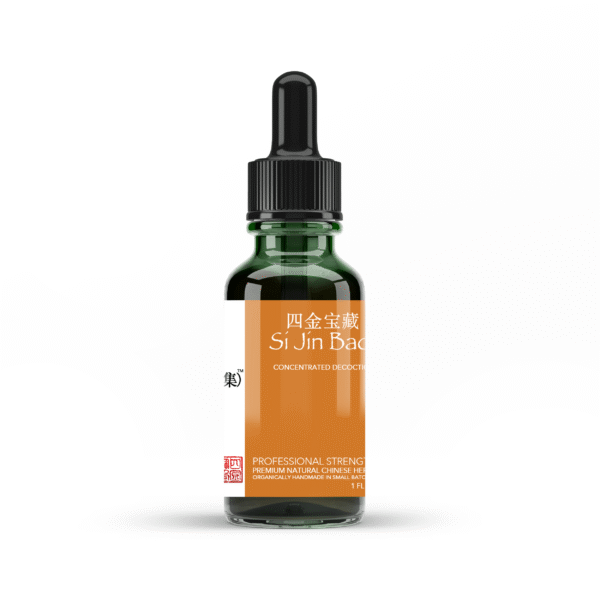
Ling Gui Zhu Gan Tang 苓桂术甘汤
Login to view prices
- ACM/CCM/TCM Global Status: Safe & Effective
Poria, Cinnamon Twig, Atractylodes, and Licorice Decoction – 1 oz
Classical Formula · Han Dynasty · c. 220 CE
苓桂朮甘湯
Poria, Cinnamon Twig, White Atractylodes & Licorice Decoction
Over Eighteen Centuries in Continuous Clinical Use
The Formula
Warm the Center, Move the Water
Líng Guì Zhú Gān Tāng — Poria, Cinnamon Twig, White Atractylodes, and Licorice Decoction — is Zhang Zhongjing’s four-herb answer to fluid that pools when the center runs cold: it warms the Spleen’s yang, transforms the retained fluid, and guides it out through the urine.
The trouble here is phlegm-fluid (痰飲, tán yǐn) — a thin, watery accumulation that gathers below the heart when Spleen yang is too weak to move it. From there it clouds the head as dizziness, harries the Heart as palpitations, and floods the Lung as a cough with clear, thin sputum. Rather than forcing the water out, this formula warms the center so the body can transform and move it on its own.
Classical Foundation
From Zhang Zhongjing’s Canon
The formula comes down from the Han-dynasty canon of Zhāng Zhòng-Jǐng, appearing in both the Shāng Hán Lùn (Treatise on Cold Damage) and the Jīn Guì Yào Lüè (Essentials from the Golden Cabinet), in its chapter on phlegm-fluid. It is the root of the celebrated “Líng-Guì” family of formulas — the prescriptions built on the pairing of Fú Líng and Guì Zhī.
A Note on Warm Medicinals
Zhang Zhongjing’s rule for this whole class of disorders is the logic of the formula: 病痰飲者,當以溫藥和之 — “for phlegm-fluid, harmonize it with warm medicinals.” The accumulation is a cold, yin fluid, so it is warmed and coaxed to move, not drained away by force.
The Pattern
Phlegm-Fluid from Spleen-Yang Deficiency · 痰飲
The pattern is a cold, weak center that can no longer transform water. Fluid gathers below the heart, giving fullness in the chest and flanks — sometimes an audible splash in the epigastrium — while the clear yang can no longer rise to the head.
Clinical Indications
- Dizziness or vertigo, worse on standing or moving the head
- Palpitations; a sensation of qi rushing up to the chest
- Fullness in the chest and hypochondrium; scanty urine
- Cough with clear, thin, watery sputum; shortness of breath
Classical tongue & pulse: a pale, swollen tongue with a white, slippery coating; a wiry and slippery — or deep — pulse.
How It Works
Four Herbs: Warm, Drain, Strengthen, Harmonize
Fú Líng takes the largest share — strengthening the Spleen and leaching the accumulated fluid downward and out through the urine, while quieting the Heart the fluid disturbs. Guì Zhī warms the yang and transforms qi, evaporating the cold, stagnant fluid like sun on standing water, and settling the qi that surges up toward the chest and head.
Bái Zhú strengthens the Spleen and dries Dampness at its source, so new fluid stops forming. And Zhì Gān Cǎo supports the Spleen qi and harmonizes the whole; with Guì Zhī it forms the classical acrid-and-sweet pairing said to generate yang, and it tempers Fú Líng’s draining so the normal fluids are spared. Fú Líng drains from below while Guì Zhī warms from above — the renowned Líng-Guì pairing, one moving the water out, the other restoring the warmth that keeps it moving.
Clinical Recognition
When to Reach for It
Reach for Líng Guì Zhú Gān Tāng when fluid pools in a cold, weak center — dizziness that worsens on standing, palpitations, chest fullness, and a cough bringing up clear, watery phlegm, with a pale, swollen tongue. It is the classical decoction for phlegm-fluid arising from Spleen-yang deficiency.
Western conditions and terminology that are commonly associated with these TCM patterns:
- Vertigo and Ménière’s disease; benign positional vertigo
- Palpitations and arrhythmia; mild congestive heart failure with fluid retention
- Chronic bronchitis; asthma in the remission phase
- Functional dyspepsia or chronic gastritis with epigastric splashing; edema; non-alcoholic fatty liver
化飲
The Si Jin Bao Preparation
Si Jin Bao’s Líng Guì Zhú Gān Tāng is a concentrated decoction prepared in small batches using traditional methods — alcohol-free, no fillers. A formula that works by warming and gently moving what has pooled is itself kept simple and clean, so the body meets only the four herbs and nothing more.
Materia Medica · 本草
苓桂朮甘湯
Líng Guì Zhú Gān Tāng
Poria, Cinnamon Twig, White Atractylodes & Licorice Decoction
Four herbs in the classical 4:3:2:2 proportion — one to drain the pooled fluid, one to warm the yang that moves it, one to strengthen the Spleen at its source, and one to harmonize. Below, each herb in its own right: nature, channels, classical actions, and its role in this formula.
01
Herb 01
茯苓
Poria (Sclerotium Poriae Cocos)
Poria
CategoryDrain Dampness · Promote Urination
Nature & FlavorSweet, Bland; Neutral
ChannelsHeart · Lung · Spleen · Kidney
Actions
Promotes urination and leaches out Dampness; strengthens the Spleen; quiets the Heart and calms the spirit.
Indications
Fluid retention and Dampness; Spleen deficiency with poor appetite; palpitations and restlessness from fluid disturbing the Heart.
Classical Reference
Recorded in the Shén Nóng Běn Cǎo Jīng (神農本草經) as a principal herb to drain Dampness and quiet the Heart.
Role in this Formula
Takes the largest share: strengthens the Spleen and leaches the accumulated fluid downward through the urine, while quieting the Heart the fluid disturbs.
02
Herb 02
桂枝
Ramulus Cinnamomi
Cinnamon Twig
CategoryWarm the Yang · Unblock the Channels
Nature & FlavorAcrid, Sweet; Warm
ChannelsHeart · Lung · Urinary Bladder
Actions
Warms and unblocks the yang; transforms qi to move water; warms the channels and frees the vessels; subdues counterflow qi that surges upward.
Indications
Yang deficiency with fluid retention; qi surging up to the chest with palpitations and dizziness; cold obstruction of the channels.
Classical Reference
Recorded in the Shén Nóng Běn Cǎo Jīng (神農本草經), long used to warm the yang and free the movement of qi.
Role in this Formula
Warms the yang and transforms qi — evaporating the cold, stagnant fluid and settling the qi that surges up toward the chest and head.
03
Herb 03
白朮
Rhizoma Atractylodis Macrocephalae
White Atractylodes Rhizome
CategoryTonify Qi · Dry Dampness
Nature & FlavorBitter, Sweet; Warm
ChannelsSpleen · Stomach
Actions
Strengthens the Spleen and augments qi; dries Dampness and promotes the movement of water.
Indications
Spleen deficiency with Dampness; fatigue, poor appetite, and loose stool; fluid retention.
Classical Reference
Recorded in the Shén Nóng Běn Cǎo Jīng (神農本草經) as a principal herb to strengthen the Spleen and dry Dampness.
Role in this Formula
Strengthens the Spleen and dries Dampness at its source, so new fluid stops forming — reinforcing Fú Líng’s work.
04
Herb 04
炙甘草
Radix Glycyrrhizae Praeparata
Honey-Fried Licorice Root
CategoryTonify Qi · Harmonize
Nature & FlavorSweet; Neutral (Warm when honey-prepared)
ChannelsHeart · Lung · Spleen · Stomach
Actions
Tonifies the Spleen and augments qi; harmonizes the other herbs; with warm, acrid herbs, helps to generate yang.
Indications
Spleen qi deficiency; the need to harmonize and moderate the herbs of a formula.
Classical Reference
Recorded in the Shén Nóng Běn Cǎo Jīng (神農本草經); honey-frying deepens its warming, Spleen-tonifying nature.
Role in this Formula
Supports the Spleen qi and harmonizes the whole; with Guì Zhī it forms the acrid-and-sweet pairing that generates yang, and it tempers Fú Líng’s draining so the normal fluids are spared.
05
Herb 05
蔬菜甘油
Glycerinum Vegetabile
Vegetable Glycerin
Nature (性)
Neutral · 平 Píng
Taste (味)
Sweet · 甘 Gān
Category
Excipient · Carrier
Traditional Actions (功效)
Harmonizes and guides the other medicinals to their target tissues. Analogous to synovial fluid — providing a medium for smooth movement and deep delivery throughout the decoction.
Role in this Formula
Excipient function: Dissolves and stabilizes the botanical constituents of the formula, ensuring consistent delivery in decoction form. Mucosal hydration: By attracting and retaining water, glycerin keeps the oral and digestive mucosa moist. Patient tolerance: Its naturally sweet, neutral profile makes the formula palatable for children and adults alike.
Modern Research
International Journal of Pharmaceutics · 2023
Glycerin serves as a co-solvent and humectant in oral liquid formulations, enhancing solubility of poorly water-soluble compounds, stabilizing active ingredients, and improving mucosal hydration.
Journal of Clinical Pharmacology · 2018
Oral glycerol has been widely used as an osmotic agent. Doses of 1–1.5 g/kg are safe and well-tolerated; its mechanism involves osmotic fluid redistribution between compartments.
Clinical Oral Investigations · 2022
Glycerin-containing oral moisturizers significantly improved xerostomia symptoms compared with water-based controls, enhancing mucosal hydration and prolonging moisture retention in the oral cavity.
Clinical Translation
Gān Yóu guides the physical delivery of the formula — ensuring the preparation reaches its target tissues and is tolerated long enough to do its work. A naturally sweet, neutral carrier that makes the decoction palatable for adults and children alike.
06
Herb 06
蒸餾水
Aqua Destillata
Distilled Water
Nature (性)
Neutral · 平 Píng
Taste (味)
Tasteless
Category
Vehicle · Neutral Carrier
Traditional Actions (功效)
Not a classical herb in its own right. Functions as a neutral carrier — a pharmaceutically pure vehicle that allows the active constituents of the classical herbs in the formula to extract, stabilize, and deliver without interference.
Role in this Formula
Biomedical role: A pharmaceutically pure solvent, ensuring consistent extraction and delivery of active compounds without introducing mineral ions, microbial contaminants, or chemical interference. Clinical relevance: Acts as a safe vehicle — analogous to saline in biomedicine — so that every dose of the formula performs identically, from the first bottle to the last.
Modern Research
Pharmacopeial Standard · Herbal Decoction Stability
Distilled water ensures stability, reproducibility, and safety in herbal decoction preparations by eliminating mineral ions and microbial contaminants that would otherwise compromise extraction consistency and shelf life.
Clinical Pharmacology · Oral Solution Vehicles
Distilled water is recognized in clinical pharmacology as the neutral carrier of choice for both intravenous and oral solutions, chosen specifically for its non-reactive profile with active ingredients.
Clinical Translation
Li Shi-zhen devoted an entire section of the Ben Cao Gang Mu (本草綱目) to the classification of waters — recognizing that the water in which a formula is prepared shapes the clinical outcome. SJB honors this principle by using pharmaceutically distilled water as the neutral vehicle for every decoction.
化飲
Warm, Drain, Strengthen, Harmonize
One herb drains the pooled fluid downward, one warms the yang that transforms it, one strengthens the Spleen so it stops reforming, and one harmonizes the whole. With only four ingredients in the classical 4:3:2:2 measure, Zhang Zhongjing covered every base — and eighteen centuries on, the pairing of Fú Líng and Guì Zhī remains the model for warming and moving what the cold center could not.
Dosage & Preparation · 用法用量
How to Prepare & Dose
Si Jin Bao Concentrated Decoctions™ are activated in hot water, steeped briefly, and taken warm. Follow the four steps below, then refer to the age-appropriate dosing grid.
Preparation
The Four Steps
-
Step 01ShakeShake the bottle well before each use.
-
Step 02Add Hot WaterAdd the age-appropriate dosage into 1 oz of hot water, as you would for tea.
-
Step 03SteepCover and steep for 5 minutes, then allow to cool to a warm, drinkable temperature.
-
Step 04DrinkDrink warm, twice daily or as directed by your practitioner.
For best results: take on an empty stomach — approximately 30 minutes before or after food or drink.
Dosage
By Age Group
Newborn
3drops
Twice daily
1 Year
7drops
Twice daily
2–6 Years
10drops
Twice daily
7 Years to Adult
20drops
Twice daily
Treatment Protocols
Suggested Clinical Course
Acute
10 Days
Then Reevaluate
Subacute
30 Days
Then Reevaluate
Chronic
90 Days
Then Reevaluate
Bottle Longevity
11½ days
at standard adult dosage
Research · 研究
苓桂朮甘湯
Líng Guì Zhú Gān Tāng
Peer-Reviewed Evidence
Seven Studies on Ling Gui Zhu Gan Tang and Its Herbs
What follows is the peer-reviewed evidence behind Líng Guì Zhú Gān Tāng — three studies of the formula itself, in cardiac rhythm, lipid-and-weight, and fatty-liver disorders, then the pharmacology of its four herbs: draining fluid, warming yang, strengthening the Spleen, and harmonizing.
01
Study 01
苓桂朮甘湯
Systematic Review & Meta-Analysis
Front. Cardiovasc. Med. · 2022
Design
Systematic review & meta-analysis (14 RCTs, 1,236 patients)
Intervention
Formula + antiarrhythmic drugs vs drugs alone
Relevance
Direct — the palpitations pattern
Background
In this pattern, cold water surges up to harry the Heart — the classical picture of palpitations. This review pooled fourteen randomized trials of the formula added to standard antiarrhythmic therapy for premature beats in coronary heart disease.
Findings
Adding the formula raised clinical effectiveness (RR 1.29) and reduced the number of 24-hour premature beats versus antiarrhythmic drugs alone, with no significant increase in adverse reactions; the authors noted a marginally high risk of bias among the included trials.
Relevance to Ling Gui Zhu Gan Tang
The formula, added to conventional care, improved a cardiac rhythm disorder — the “water qi assaulting the Heart” that its warming, fluid-transforming action was built to address.
Citation
Effectiveness and safety of Linggui Zhugan decoction for the treatment of premature contraction in patients with coronary heart disease: A systematic review and meta-analysis. Front. Cardiovasc. Med. 2022;9:1002378. PMID: 36407468.
02
Study 02
苓桂朮甘湯
Systematic Review + Network Pharmacology
Evid. Based Complement. Alternat. Med. · 2022
Design
Meta-analysis of RCTs + network pharmacology
Active Compounds
Whole formula
Relevance
Direct — the phlegm-damp pattern
Background
Phlegm-damp accumulation is the TCM lens on lipid and weight disorders. This study combined a meta-analysis of randomized trials with network pharmacology to assess the formula’s effect on serum lipids and obesity.
Findings
The pooled clinical evidence suggested reductions in triglycerides, total cholesterol, and body weight; the network analysis identified candidate targets involved in lipid metabolism.
Relevance to Ling Gui Zhu Gan Tang
Supports the formula’s traditional action against phlegm-damp accumulation, read here as improved lipid and weight measures.
Citation
Clinical Evidence and Potential Mechanisms of Complementary Treatment of Ling Gui Zhu Gan Formula for the Management of Serum Lipids and Obesity. Evid. Based Complement. Alternat. Med. 2022;2022:7714034. PMID: 35602812.
03
Study 03
苓桂朮甘湯
Preclinical Mechanistic Study (Mice)
Microbiol. Spectr. · 2024
Design
In vivo (high-fat-diet mice); metagenomics / metabolomics / transcriptomics
Active Compounds
Whole formula
Relevance
Mechanistic — fluid / phlegm-damp metabolism
Background
Non-alcoholic fatty liver disease is a modern correlate of phlegm-damp accumulation. This study probed how the formula acts in high-fat-diet mice.
Findings
The formula improved liver function and reduced hepatic lipid droplets, reshaped the gut microbiota and strengthened the intestinal barrier, and corrected bile-acid metabolism via Fgf15/FXR in the ileum and CYP7A1/FXR in the liver, with higher short-chain fatty acids.
Relevance to Ling Gui Zhu Gan Tang
Gives a molecular reading of the formula’s fluid-and-damp-transforming action — restoring metabolism rather than forcing it.
Citation
Ling-Gui-Zhu-Gan decoction ameliorates nonalcoholic fatty liver disease via modulating the gut microbiota. Microbiol. Spectr. 2024;12(6):e0197923. PMID: 38647315.
04
Study 04
茯苓
Comprehensive Review
J. Ethnopharmacol. · 2025
Design
Comprehensive review
Active Compounds
Triterpenes (pachymic acid, poricoic acids), polysaccharides (β-glucan)
Relevance
Direct — diuretic, drains Dampness
Background
Fú Líng drains Dampness and promotes urination. This review compiled the phytochemistry and pharmacology of Poria cocos.
Findings
Poria is documented for diuretic, anti-inflammatory, antioxidant, and immunomodulatory activity, with triterpenes and polysaccharides as its principal constituents.
Relevance to Ling Gui Zhu Gan Tang
Fú Líng leaches the retained fluid downward through the urine; this review documents the diuretic pharmacology behind that leading role.
Citation
A multidimensional perspective on Poria cocos, an ancient fungal traditional Chinese medicine. J. Ethnopharmacol. 2025. PMID: 40280371.
05
Study 05
桂枝
Comprehensive Review
J. Pharm. Pharmacol. · 2020
Design
Comprehensive review
Active Compounds
Cinnamaldehyde, cinnamic acid (volatile oil)
Relevance
Direct — warms yang, anti-inflammatory
Background
Guì Zhī warms the yang and transforms qi. This review summarized the traditional uses, chemistry, and pharmacology of Cinnamomi ramulus.
Findings
The herb and its principal compound cinnamaldehyde are documented for anti-inflammatory, antibacterial, antiviral, antipyretic, and antidiabetic activity.
Relevance to Ling Gui Zhu Gan Tang
Guì Zhī warms the yang that transforms the cold, stagnant fluid; this review documents the pharmacology of cinnamaldehyde behind that warming role.
Citation
The traditional uses, phytochemistry, pharmacology and toxicology of Cinnamomi ramulus: a review. J. Pharm. Pharmacol. 2020;72(3):319. PMID: 31750548.
06
Study 06
白朮
Comprehensive Review
Front. Pharmacol. · 2021
Design
Comprehensive review
Active Compounds
Sesquiterpenoids (atractylenolides), polysaccharides
Relevance
Direct — strengthens Spleen, dries Dampness
Background
Bái Zhú strengthens the Spleen and dries Dampness. This review compiled the ethnopharmacology, chemistry, and pharmacology of Baizhu.
Findings
Baizhu is documented for diuretic, anti-inflammatory, and gastrointestinal-regulating activity, with atractylenolides and polysaccharides as its key constituents.
Relevance to Ling Gui Zhu Gan Tang
Bái Zhú strengthens the Spleen at its source so new fluid stops forming; this review documents the Spleen-supporting, dampness-drying pharmacology behind that role.
Citation
A Review of the Ethnopharmacology, Phytochemistry, Pharmacology, Application, Quality Control, Processing, Toxicology, and Pharmacokinetics of the Dried Rhizome of Atractylodes macrocephala. Front. Pharmacol. 2021;12:727154. PMCID: PMC8595830.
07
Study 07
甘草
Phytochemical / Pharmacological Review
Phytother. Res. · 2018
Design
Phytochemical / pharmacological review
Active Compounds
Triterpenes (glycyrrhizin, glycyrrhetinic acid)
Relevance
Supporting — tonifies Spleen qi, harmonizes
Background
Gān Cǎo — here honey-fried — tonifies the Spleen qi and harmonizes a formula. This review summarized the chemistry and pharmacology of licorice.
Findings
Glycyrrhizin and glycyrrhetinic acid are documented for anti-inflammatory and antiallergic activity, with broad use across formulas to moderate and harmonize.
Relevance to Ling Gui Zhu Gan Tang
Zhì Gān Cǎo supports the Spleen qi and harmonizes the whole; the review documents the anti-inflammatory pharmacology behind that role.
Citation
Liquorice (Glycyrrhiza glabra): A phytochemical and pharmacological review. Phytother. Res. 2018. PMCID: PMC7167772.
Mechanism Notes
How the formula’s herbs work at a biochemical level.
Fú Líng
Triterpenes (pachymic acid, poricoic acids) and polysaccharides documented for diuretic, anti-inflammatory, and antioxidant activity (PMID 40280371, 2025).
Guì Zhī
Cinnamaldehyde and cinnamic acid documented for anti-inflammatory, antipyretic, and antibacterial activity (PMID 31750548, 2020).
Bái Zhú
Atractylenolides (sesquiterpenoids) and polysaccharides documented for diuretic, anti-inflammatory, and gastrointestinal-regulating activity (PMC8595830, 2021).
Zhì Gān Cǎo
Glycyrrhizin and glycyrrhetinic acid documented for anti-inflammatory and antiallergic activity, harmonizing the formula (PMC7167772, 2018).
Western Terminology
Western conditions and terminology commonly associated with these TCM patterns:
Vertigo & Ménière’s Disease · Cardiac Arrhythmia & Premature Beats · Palpitations · Chronic Bronchitis · Asthma (Remission) · Congestive Heart Failure with Fluid Retention · Edema · Chronic Gastritis · Non-Alcoholic Fatty Liver · Obesity
化飲
Warm, and It Moves
Studied as a whole, the formula has been read into the modern clinic along the lines the classics drew: cardiac rhythm and palpitations where fluid harries the Heart, and lipid, weight, and fatty-liver measures where phlegm-damp gathers. Beneath it, each of the four herbs has been examined on its own — Fú Líng draining, Guì Zhī warming, Bái Zhú strengthening, Gān Cǎo harmonizing. Eighteen centuries on, the mechanisms now have names for what Zhang Zhongjing set down in one line: warm the cold water, and it moves.
Related products
-

Ban Lan Gen Tang 板藍根湯
Login to view prices -
Cang Er Zi Tang 蒼耳子湯
Login to view prices -
Dang Gui Si Ni Tang 當歸四逆湯(集)
Login to view prices -
Bu Zhong Yi Qi Tang 補中益氣湯
Login to view prices

Reviews
There are no reviews yet.