Enjoy Free US Domestic Shipping on Orders Over $400+

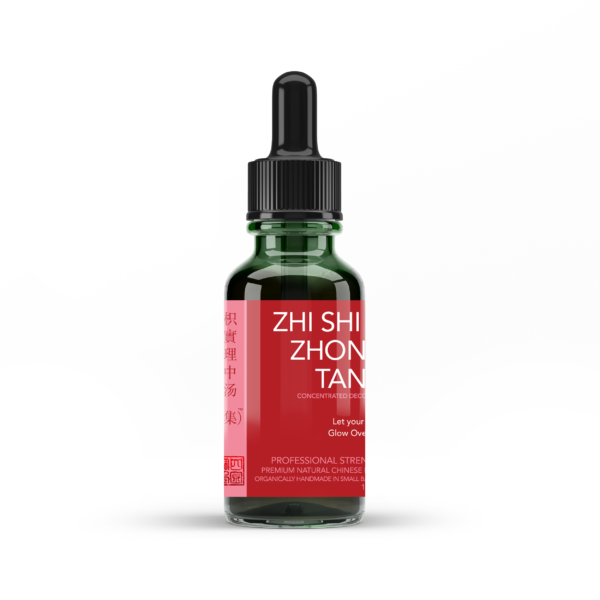
Zhi Shi Li Zhong Tang 枳實理中湯(集)
Login to view prices
- ACM/CCM/TCM Global Status: Safe & Effective
Let Your Inner Glow Overflow™
Zhi Shi Li Zhong Tang Concentrated Decoction™ is Si Jin Bao’s proprietary formula designed to warm and rectify the Middle Jiao, expel Cold, and move Qi stagnation in the digestive and abdominal channels. Building on the classical Li Zhong Tang framework, this formula adds Zhi Shi (Immature Bitter Orange) to break accumulation and descend rebellious Qi, while Gan Jiang and Ren Shen restore Yang and replenish the original Qi of the Spleen and Stomach. It is indicated for patterns of Cold accumulation in the Middle Jiao with concurrent Qi stagnation — particularly where digestive weakness, abdominal fullness, and cold extremities present together.
Si Jin Bao Proprietary Formula · 1999
枳實理中湯
Regulate the Middle Decoction with Immature Bitter Orange
Let Your Inner Glow Overflow™
Over a Quarter-Century in Service
The Formula
A Cold, Stalled Middle — Warmed and Set Moving
Zhi Shi Li Zhong Tang is Si Jin Bao’s proprietary extension of the classical Li Zhong Tang — built to warm and rectify the Middle Jiao, expel Cold, and move the Qi that has stalled in the digestive center.
When the Middle Jiao turns cold and weak, digestion slows, food and Qi stop moving, and the body’s warmth no longer reaches the limbs. This formula restores the Spleen and Stomach’s warming, transforming function — and adds Zhi Shi to break the accumulation and send rebellious Qi downward. A cold, stalled middle is both warmed and set moving again.
The Foundation
Built on Li Zhong Tang
Li Zhong Tang — the “Regulate the Middle Decoction” — is one of the foundational warming formulas of the classical canon, recorded in Zhang Zhongjing’s Shāng Hán Lùn for Cold from deficiency of the Middle Jiao. Its four herbs — Ren Shen, Gan Jiang, Bai Zhu, and Zhi Gan Cao — warm the center and rebuild Spleen and Stomach Qi.
This proprietary formula builds on that frame. It adds Zhi Fu Zi to deepen the Yang-restoring, Cold-dispelling action — the move that classically defines Fu Zi Li Zhong Tang — and Zhi Shi to break accumulation and descend rebellious Qi. The result extends the classical formula to patterns where Cold deficiency and Qi stagnation present together.
A Note on the Middle Jiao
The Middle Jiao — the Spleen and Stomach — is the body’s center of transformation, where food becomes Qi and Blood. When it runs cold and weak, everything downstream slows: appetite fades, the abdomen fills, the stool loosens, and warmth fails to reach the hands and feet. Warm and rebuild the center, and the rest follows.
The Pattern
Cold in the Middle Jiao with Qi Stagnation · 中焦虛寒氣滯
The pattern this formula answers is Cold from deficiency of the Middle Jiao with concurrent Qi stagnation — digestive weakness, abdominal fullness, and cold extremities presenting together. The center is too cold to transform food and too stalled to move it, and the cold reaches outward to the limbs.
Clinical Indications
- Abdominal pain & cramping; bloating & distension
- Epigastric fullness; chest oppression
- Poor appetite; nausea & vomiting; hiccups; acid reflux
- Loose stools; cold-type diarrhea; irritable bowel
- Cold extremities
- Fatigue & low energy; weakness & pallor
How It Works
Six Herbs: Warm, Tonify, Move
Gān Jiāng and Zhì Fù Zǐ carry the warming work. Gan Jiang warms the Middle Jiao and expels Cold at the formula’s center; Zhi Fu Zi restores Yang and drives Cold from the interior, reaching the cold extremities the center can no longer warm.
Rén Shēn, Bái Zhú, and Zhì Gān Cǎo rebuild — the classical Li Zhong core. They tonify Spleen and Stomach Qi and replenish the original Qi, while Bai Zhu dries the Damp that pools in a cold, weak middle and Zhi Gan Cao harmonizes the whole.
Zhǐ Shí moves. It breaks the accumulation and descends rebellious Qi — resolving the fullness, distension, and counterflow (reflux, hiccups, nausea) that warming and tonifying alone would leave behind. Warm the cold, rebuild the weak, move the stalled.
Clinical Recognition
When to Reach for It
Reach for Zhi Shi Li Zhong Tang when digestion is cold, weak, and stalled — the patient who is chilled and tired, bloated after eating, with poor appetite and loose stools, whose hands and feet stay cold. It suits chronic, functional digestive complaints that trace to a cold, deficient center rather than to heat or excess.
Western conditions and terminology that are commonly associated with these TCM patterns:
- Irritable bowel syndrome, functional dyspepsia, chronic gastritis, colitis
- Gastroparesis, SIBO, malabsorption, post-surgical digestive weakness
- Hypothyroidism, adrenal insufficiency, chronic fatigue
- Raynaud’s phenomenon, hypotension
理中
The Si Jin Bao Preparation
Si Jin Bao’s Zhi Shi Li Zhong Tang is a concentrated decoction prepared in small batches using traditional methods — alcohol-free, no fillers. A formula that warms the center deserves to be made with the same steady care it restores.
Materia Medica · 本草
枳實理中湯
Zhǐ Shí Lǐ Zhōng Tāng
Regulate the Middle Decoction with Immature Bitter Orange
Let Your Inner Glow Overflow
Built on the classical Li Zhong Tang frame, this formula brings together six herbs that warm the cold Middle Jiao, rebuild Spleen and Stomach Qi, and move what has stalled. The cards below detail the nature, flavor, channels, and actions of each — drawn from the classical materia medica — along with how each functions within this specific formula.
01
Herb 01
人蔘
Radix et Rhizoma Ginseng
Ginseng Root
Category
Tonifies the Qi
Nature & Flavor
Sweet, slightly bitter · Slightly warm
Channels
Spleen · Lung · Heart
Actions
Powerfully tonifies the original Qi; tonifies Spleen and Lung Qi; generates fluids; calms the spirit. The premier Qi tonic of the materia medica, relied upon to rebuild a depleted center.
Indications
Spleen and Stomach Qi deficiency with poor appetite and fatigue; collapse of the original Qi; weak digestion underlying chronic depletion.
Classical Reference
An upper-grade herb of the Shén Nóng Běn Cǎo Jīng, Rén Shēn is the classical chief of the Qi tonics — the herb reached for first when the body’s foundational Qi must be restored.
Role in this Formula
Rebuilds the original Qi of the Spleen and Stomach — the tonifying heart of the Li Zhong core, restoring the center’s power to transform.
02
Herb 02
白术
Rhizoma Atractylodis Macrocephalae
White Atractylodes Rhizome
Category
Tonifies the Qi
Nature & Flavor
Sweet, bitter · Warm
Channels
Spleen · Stomach
Actions
Tonifies the Spleen and augments the Qi; dries Dampness and promotes water metabolism; stabilizes the exterior. The principal herb for strengthening a damp, weak Spleen.
Indications
Spleen deficiency with Dampness; loose stools and fatigue; reduced appetite with a sense of heaviness; fluid accumulation from a weak middle.
Classical Reference
Recorded among the herbs of the Shén Nóng Běn Cǎo Jīng (as 术), Bái Zhú has long been paired with Rén Shēn as the core of Spleen-strengthening formulas.
Role in this Formula
Strengthens the Spleen and dries the Damp that pools when the middle is cold and weak — the drying, stabilizing partner to Ren Shen’s tonification.
03
Herb 03
乾薑
Rhizoma Zingiberis
Dried Ginger Rhizome
Category
Warms the Interior & Expels Cold
Nature & Flavor
Acrid · Hot
Channels
Spleen · Stomach · Heart · Lung
Actions
Warms the Middle Jiao and expels Cold; rescues devastated Yang; warms the Lungs and transforms thin Phlegm. The classical warming herb for a cold, deficient center.
Indications
Cold from deficiency of the Middle Jiao; abdominal cold and pain; vomiting and diarrhea from cold; cold-pattern digestive weakness.
Classical Reference
Recorded in the Shén Nóng Běn Cǎo Jīng, Gān Jiāng is the warming center of Li Zhong Tang itself — the herb Zhang Zhongjing used to drive Cold from the middle.
Role in this Formula
Warms the Middle Jiao and expels Cold at the formula’s center — the source of its warming force.
04
Herb 04
附子
Radix Aconiti Lateralis Praeparata
Prepared Aconite (Lateral Root)
Category
Warms the Interior & Restores Yang
Nature & Flavor
Acrid, sweet · Hot (prepared)
Channels
Heart · Kidney · Spleen
Actions
Restores devastated Yang; warms the Spleen and Kidney Yang and disperses Cold; warms the channels and stops pain. Always used prepared, to temper its potency. The deepest Yang-warming herb in the materia medica.
Indications
Yang deficiency with interior Cold; cold extremities; weak digestion and aversion to cold from a deficient center; cold pain in the abdomen.
Classical Reference
Recorded in the Shén Nóng Běn Cǎo Jīng and used extensively by Zhang Zhongjing, Zhì Fù Zǐ is the herb that, added to Li Zhong Tang, classically forms Fu Zi Li Zhong Tang — deepening the formula’s reach into Yang deficiency.
Role in this Formula
Restores Yang and drives Cold from the interior, reaching the cold extremities the weakened center can no longer warm — deepening Gan Jiang’s warming action.
05
Herb 05
炙甘草
Radix Glycyrrhizae Praeparata
Honey-Fried Licorice Root
Category
Tonifies the Qi
Nature & Flavor
Sweet · Warm
Channels
Heart · Lung · Spleen · Stomach
Actions
Tonifies the Spleen and augments Qi; warms and benefits the Heart Qi; harmonizes the actions of the other herbs and moderates their nature. Honey-frying deepens its warming, tonifying character.
Indications
Spleen and Stomach Qi deficiency; fatigue and weak digestion; used throughout the materia medica to harmonize and steady complex formulas.
Classical Reference
Gān Cǎo is recorded in the Shén Nóng Běn Cǎo Jīng; in honey-prepared form it is the classical harmonizer of the Qi tonics, present in Li Zhong Tang to bind and moderate the whole.
Role in this Formula
Tonifies the middle and harmonizes the warming and moving herbs — holding the formula together so its parts work as one.
06
Herb 06
枳實
Fructus Aurantii Immaturus
Immature Bitter Orange
Category
Regulates the Qi
Nature & Flavor
Bitter, acrid · Slightly cold
Channels
Spleen · Stomach · Large Intestine
Actions
Breaks up Qi stagnation and reduces accumulation; descends rebellious Qi and relieves distension; transforms Phlegm. The strongest Qi-breaking herb of the abdomen.
Indications
Abdominal and epigastric fullness and distension; food accumulation; constipation or sluggish bowels from Qi stagnation; rebellious Qi with belching and reflux.
Classical Reference
Recorded in the Shén Nóng Běn Cǎo Jīng, Zhǐ Shí is the classical herb for breaking stubborn accumulation and distension in the middle — the addition that gives this formula its name.
Role in this Formula
The proprietary addition to the Li Zhong frame: breaks accumulation and descends rebellious Qi, resolving the fullness, distension, and counterflow that warming and tonifying alone would leave behind.
07
Herb 07
蔬菜甘油
Glycerinum Vegetabile
Vegetable Glycerin
Nature (性)
Neutral · 平 Píng
Taste (味)
Sweet · 甘 Gān
Category
Excipient · Carrier
Traditional Actions (功效)
Harmonizes and guides the other medicinals to their target tissues. Analogous to synovial fluid — providing a medium for smooth movement and deep delivery throughout the decoction.
Role in this Formula
Excipient function: Dissolves and stabilizes the botanical constituents of the formula, ensuring consistent delivery in decoction form. Mucosal hydration: By attracting and retaining water, glycerin keeps the oral and digestive mucosa moist. Patient tolerance: Its naturally sweet, neutral profile makes the formula palatable for children and adults alike.
Modern Research
International Journal of Pharmaceutics · 2023
Glycerin serves as a co-solvent and humectant in oral liquid formulations, enhancing solubility of poorly water-soluble compounds, stabilizing active ingredients, and improving mucosal hydration.
Journal of Clinical Pharmacology · 2018
Oral glycerol has been widely used as an osmotic agent. Doses of 1–1.5 g/kg are safe and well-tolerated; its mechanism involves osmotic fluid redistribution between compartments.
Clinical Oral Investigations · 2022
Glycerin-containing oral moisturizers significantly improved xerostomia symptoms compared with water-based controls, enhancing mucosal hydration and prolonging moisture retention in the oral cavity.
Clinical Translation
Gān Yóu guides the physical delivery of the formula — ensuring the preparation reaches its target tissues and is tolerated long enough to do its work. A naturally sweet, neutral carrier that makes the decoction palatable for adults and children alike.
08
Herb 08
蒸餾水
Aqua Destillata
Distilled Water
Nature (性)
Neutral · 平 Píng
Taste (味)
Tasteless
Category
Vehicle · Neutral Carrier
Traditional Actions (功效)
Not a classical herb in its own right. Functions as a neutral carrier — a pharmaceutically pure vehicle that allows the active constituents of the classical herbs in the formula to extract, stabilize, and deliver without interference.
Role in this Formula
Biomedical role: A pharmaceutically pure solvent, ensuring consistent extraction and delivery of active compounds without introducing mineral ions, microbial contaminants, or chemical interference. Clinical relevance: Acts as a safe vehicle — analogous to saline in biomedicine — so that every dose of the formula performs identically, from the first bottle to the last.
Modern Research
Pharmacopeial Standard · Herbal Decoction Stability
Distilled water ensures stability, reproducibility, and safety in herbal decoction preparations by eliminating mineral ions and microbial contaminants that would otherwise compromise extraction consistency and shelf life.
Clinical Pharmacology · Oral Solution Vehicles
Distilled water is recognized in clinical pharmacology as the neutral carrier of choice for both intravenous and oral solutions, chosen specifically for its non-reactive profile with active ingredients.
Clinical Translation
Li Shi-zhen devoted an entire section of the Ben Cao Gang Mu (本草綱目) to the classification of waters — recognizing that the water in which a formula is prepared shapes the clinical outcome. SJB honors this principle by using pharmaceutically distilled water as the neutral vehicle for every decoction.
理中
Warm, Tonify, Move
Two herbs warm the cold center; three rebuild the Spleen and Stomach Qi that the cold has weakened; and one breaks the accumulation and sends the rebellious Qi down. Built on the classical Li Zhong frame and extended with Zhi Fu Zi and Zhi Shi, the six work as a single instruction — warm what is cold, rebuild what is weak, and move what has stalled.
Dosage & Preparation · 用法用量
How to Prepare & Dose
Si Jin Bao Concentrated Decoctions™ are activated in hot water, steeped briefly, and taken warm. Follow the four steps below, then refer to the age-appropriate dosing grid.
Preparation
The Four Steps
-
Step 01ShakeShake the bottle well before each use.
-
Step 02Add Hot WaterAdd the age-appropriate dosage into 1 oz of hot water, as you would for tea.
-
Step 03SteepCover and steep for 5 minutes, then allow to cool to a warm, drinkable temperature.
-
Step 04DrinkDrink warm, twice daily or as directed by your practitioner.
For best results: take on an empty stomach — approximately 30 minutes before or after food or drink.
Dosage
By Age Group
Newborn
3drops
Twice daily
1 Year
7drops
Twice daily
2–6 Years
10drops
Twice daily
7 Years to Adult
20drops
Twice daily
Treatment Protocols
Suggested Clinical Course
Acute
10 Days
Then Reevaluate
Subacute
30 Days
Then Reevaluate
Chronic
90 Days
Then Reevaluate
Bottle Longevity
11½ days
at standard adult dosage
Research · 研究
枳實理中湯
Zhǐ Shí Lǐ Zhōng Tāng
Peer-Reviewed Evidence
Six Studies on the Herbs in Zhi Shi Li Zhong Tang
What follows is the peer-reviewed evidence on the six herbs that compose this formula — each selected for a documented role in warming the Middle Jiao, rebuilding Spleen and Stomach Qi, reviving Yang, or restoring digestive motility.
01
Study 01
人蔘
Clinical & Preclinical Systematic Review
Front. Pharmacol. · 2020
Design
Systematic review — 8 RCTs and 30 preclinical studies
Active Compounds
Ginsenosides (saponins)
Relevance
Direct — the Qi-tonifying core
Background
Panax ginseng has been used to benefit Qi for centuries, and fatigue is a complex, multidimensional symptom of many illnesses. This review systematically assessed ginseng and its compounds for fatigue across both randomized clinical trials and preclinical animal studies.
Findings
Eight eligible RCTs and thirty animal studies were identified. Ginseng and its ginsenoside constituents showed anti-fatigue activity, alongside documented antioxidant, neuroprotective, and anti-inflammatory effects — modern support for the herb’s traditional Qi-benefiting use.
Relevance to Zhi Shi Li Zhong Tang
Rén Shēn rebuilds the original Qi of a cold, weak middle. This review supplies clinical and preclinical support for its anti-fatigue, Qi-restoring action — the foundation of the formula’s tonifying core.
Citation
Lin Y, et al. Clinical and Preclinical Systematic Review of Panax ginseng C. A. Mey and Its Compounds for Fatigue. Frontiers in Pharmacology. 2020. PMCID: PMC7379339.
02
Study 02
白术
Comprehensive Pharmacological Review
Front. Pharmacol. · 2021
Design
Comprehensive review — phytochemistry & pharmacology
Active Compounds
Sesquiterpenoids, polysaccharides, polyacetylenes
Relevance
Direct — spleen-strengthening, damp-drying
Background
Bái Zhú — the dried rhizome of Atractylodes macrocephala — invigorates the Spleen, replenishes Qi, and removes Dampness in classical use. This review consolidated its chemistry and pharmacology across the literature.
Findings
The review documented regulation of gastrointestinal function, anti-inflammatory and immune-modulating activity, and antioxidant effects, with sesquiterpenoids, polysaccharides, and polyacetylenes identified as the principal active constituents.
Relevance to Zhi Shi Li Zhong Tang
Bái Zhú strengthens the Spleen and dries the Damp that pools in a cold, weak middle. The review’s documented GI-regulating and anti-inflammatory actions are the modern correlate of that role.
Citation
Yang L, et al. A Review of the Ethnopharmacology, Phytochemistry, Pharmacology, Application, Quality Control, Processing, Toxicology, and Pharmacokinetics of the Dried Rhizome of Atractylodes macrocephala. Frontiers in Pharmacology. 2021. PMCID: PMC8595830.
03
Study 03
乾薑
Systematic Review of Clinical Trials
Food Sci. Nutr. · 2019
Design
Systematic review of human clinical trials
Active Compounds
Gingerols, shogaols
Relevance
Direct — warms the middle, expels cold
Background
Ginger (the rhizome of Zingiber officinale; Gān Jiāng in its dried form) has a long history of use for digestive complaints. This review summarized the clinical-trial evidence for ginger across gastrointestinal disorders.
Findings
Ginger was beneficial for nausea and showed value across gastrointestinal symptoms including vomiting and bloating, with documented anti-inflammatory, antioxidant, and antiulcer effects and an influence on gastric motility.
Relevance to Zhi Shi Li Zhong Tang
Gān Jiāng is the warming center of the formula. This clinical-trial review supports its action on nausea, motility, and digestive function in a cold, stalled middle.
Citation
Nikkhah Bodagh M, et al. Ginger in gastrointestinal disorders: A systematic review of clinical trials. Food Science & Nutrition. 2019. PMCID: PMC6341159.
04
Study 04
附子
Review of Molecular Mechanisms
Front. Pharmacol. · 2022
Design
Mechanistic review — cardiotonic effects & constituents
Active Compounds
Aconite alkaloids; higenamine, coryneine
Relevance
Direct — restores Yang, disperses cold
Background
Fuzi — the processed lateral root of Aconitum carmichaelii — is the classical herb for “restoring devastated Yang.” This review collated its cardiotonic mechanisms and active constituents.
Findings
The review documented cardiotonic activity applied in heart failure and Yang-collapse states, with water-soluble alkaloids and constituents such as higenamine contributing to the cardiac-strengthening effect. It also details the herb’s cardiotoxicity and the necessity of proper processing — the basis for using only the prepared form.
Relevance to Zhi Shi Li Zhong Tang
Zhì Fù Zǐ restores Yang and drives Cold from the interior toward the extremities. This review supplies mechanistic support for that warming, Yang-reviving action — deployed here in prepared form within a balanced formula.
Citation
Zhang J, et al. Processed lateral root of Aconitum carmichaelii Debx.: A review of cardiotonic effects and cardiotoxicity on molecular mechanisms. Frontiers in Pharmacology. 2022. DOI: 10.3389/fphar.2022.1026219.
05
Study 05
炙甘草
DSS-Induced Colitis Model
Evid. Based Complement. Alternat. Med. · 2022
Design
Controlled animal study (DSS-induced colitis)
Active Compounds
Glycyrrhiza polysaccharide (GPS)
Relevance
Direct — tonifies the middle, harmonizes
Background
Licorice (Gān Cǎo) is noted for anti-inflammatory and anti-ulcerative effects and digestive applications, though its active components remain incompletely defined. This study tested its polysaccharide fraction in a colitis model.
Findings
Glycyrrhiza polysaccharide reduced disease-activity scores, preserved colon length, lowered intestinal permeability, and improved mucosal integrity, with anti-inflammatory effects comparable to the reference drug — supporting licorice’s gut-protective, anti-inflammatory action.
Relevance to Zhi Shi Li Zhong Tang
Zhì Gān Cǎo tonifies the middle and harmonizes the formula. This study supports its anti-inflammatory, mucosa-protective contribution within the digestive tract.
Citation
Huang C, et al. Glycyrrhiza Polysaccharide Alleviates Dextran Sulfate Sodium-Induced Ulcerative Colitis in Mice. Evidence-Based Complementary and Alternative Medicine. 2022. PMCID: PMC9012628.
06
Study 06
枳實
Delayed Gastric Emptying Model
Pharm. Biol. · 2023
Design
Controlled animal study (delayed gastric emptying)
Active Compounds
Naringin, hesperidin, neohesperidin
Relevance
Direct — breaks accumulation, descends Qi
Background
Citrus aurantium — the source plant of Zhǐ Shí — is used as a prokinetic in traditional formulas. This study evaluated its extract in mice with multistress-induced delayed gastric emptying.
Findings
Treatment significantly reduced the gastric residual rate and raised serum serotonin (5-HT), motilin, and substance P, with corresponding changes in 5-HT4 receptor and c-kit expression in the gastric antrum — direct evidence of restored gastric motility.
Relevance to Zhi Shi Li Zhong Tang
Zhǐ Shí is the proprietary addition that breaks accumulation and descends rebellious Qi. This study supplies direct, mechanism-level support for its prokinetic, motility-restoring action — the move that resolves fullness, distension, and counterflow.
Citation
Prokinetic effects of Citrus reticulata and Citrus aurantium extract with/without Bupleurum chinense using multistress-induced delayed gastric emptying models. Pharmaceutical Biology. 2023. PMCID: PMC9897790.
Mechanism Notes
How the herbs work at a biochemical level.
Rén Shēn
Ginsenosides documented for anti-fatigue activity alongside antioxidant, neuroprotective, and anti-inflammatory effects — a modern correlate of the herb’s Qi-benefiting action (PMC7379339, 2020).
Bái Zhú
Sesquiterpenoids, polysaccharides, and polyacetylenes documented for regulation of gastrointestinal function and anti-inflammatory, immune-modulating activity (PMC8595830, 2021).
Gān Jiāng
Gingerols and shogaols of Zingiber officinale documented in clinical trials for relief of nausea and benefit across GI symptoms, with antiulcer and gastric-motility effects (PMC6341159, 2019).
Zhì Fù Zǐ
Aconite constituents, including water-soluble alkaloids and higenamine, documented for cardiotonic, Yang-reviving activity — used in prepared form to temper the alkaloid toxicity (Front. Pharmacol., DOI 10.3389/fphar.2022.1026219, 2022).
Zhì Gān Cǎo
Glycyrrhiza polysaccharide documented to reduce colonic inflammation, lower intestinal permeability, and protect mucosal integrity in a colitis model (PMC9012628, 2022).
Zhǐ Shí
Citrus aurantium flavonoids (naringin, hesperidin) documented to reduce gastric residual rate and raise serum 5-HT, motilin, and substance P, restoring gastric motility (PMC9897790, 2023).
Western Terminology
Western conditions and terminology commonly associated with these TCM patterns:
Irritable Bowel Syndrome · Gastroparesis · Chronic Gastritis · Functional Dyspepsia · Colitis · Small Intestinal Bacterial Overgrowth (SIBO) · Hypothyroidism · Chronic Fatigue · Raynaud’s Phenomenon · Adrenal Insufficiency · Malabsorption Syndrome · Post-surgical Digestive Weakness · Hypotension
溫中散寒
Warm the cold, move the stalled
No herb here was published under the name Zhi Shi Li Zhong Tang — it is a proprietary composition built on a classical frame. But each of its six members has been examined on its own terms, and the findings converge on what the classics described: a cold, weak, stalled middle restored by warming, rebuilding, and moving. The studies name the mechanisms — anti-fatigue and Qi-restoring, spleen-regulating and anti-inflammatory, warming and anti-nausea, Yang-reviving and cardiotonic, gut-protective, and prokinetic. The instruction underneath has not changed: warm what is cold, rebuild what is weak, and set the middle moving again.
Related products
-

Custom Concentrated Decoction™
Login to view prices -
Ban Lan Gen Tang 板藍根湯
Login to view prices -
Bu Zhong Yi Qi Tang 補中益氣湯
Login to view prices -
Dao Chi San Tang 導赤散湯
Login to view prices

Reviews
There are no reviews yet.